Korea's platform workers are testing the boundaries of the social safety net
Government-commissioned surveys counted roughly 880,000 South Koreans working through digital platforms by 2023, up from about 660,000 two years earlier — growth that has forced a rethink of a welfare system built around the standard employee.
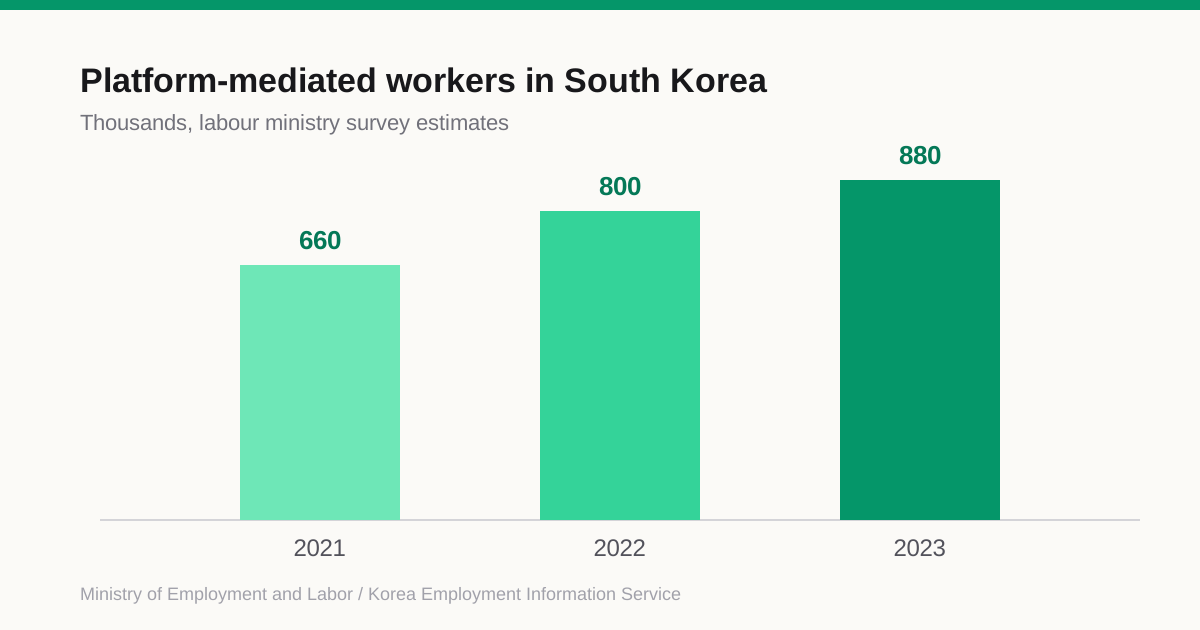
The delivery rider weaving through Seoul traffic is the visible face of a broader shift in how Koreans work. Surveys commissioned by the labour ministry with the Korea Employment Information Service put the number of people whose work is arranged and paid through digital platforms at roughly 660,000 in 2021, around 800,000 in 2022 and about 880,000 in 2023 — a few percent of total employment, concentrated in delivery and transport but spreading into care work, IT development, design and domestic services.
What makes the group a policy problem is not its size but its shape. Korean labour and social insurance law was written around a binary: you are an employee, with severance, insurance and dismissal protection, or you are self-employed and on your own. Platform workers sit between. The app sets their prices, monitors their performance and can deactivate them — employer-like powers — while bearing none of an employer’s obligations, since the worker is formally an independent contractor.
Korea has moved earlier than many countries to close parts of the gap. Employment insurance was extended to major categories of dependent contractors and platform workers beginning in 2021, and industrial-accident insurance followed, shedding the old requirement that a worker serve a single company to qualify — a rule that had excluded precisely the multi-app couriers most at risk. Delivery riders’ unions have won collective agreements with platform operators, an outcome courts and labour tribunals enabled by reading employee-like status expansively in several cases.
The unfinished part is everything insurance does not cover. Platform algorithms decide allocation and pay in ways workers cannot see or contest; income volatility defeats systems — loans, leases, welfare eligibility — designed around steady wages; and the physical toll of piece-rate delivery work shows up in accident statistics that rise with every promotion the apps run. Surveys consistently find that most platform workers value the flexibility and would not trade it for standard employment — what they want is the flexibility without the exposure.
That preference frames the policy debate now under way in Seoul, as elsewhere: whether to force platform work into the employee category, as parts of Europe have attempted, or to build a third status with portable, pro-rated protections that follow the worker across apps. Korea’s incremental extensions of insurance amount to a wager on the second path, taken one scheme at a time.
The stakes reach beyond the platforms. Every economy is watching its standard-employment share erode at the edges; Korea, with its rapid platform adoption and strong survey infrastructure, is simply seeing the change earlier and measuring it better. The 880,000 are, in that sense, an advance party.