After a decade of measurement, NIST reports a value for Newton's constant below the French benchmark
A NIST team using a torsion balance measured the gravitational constant at 6.67387×10⁻¹¹ m³/kg/s², 0.0235% lower than a 2007 result from the International Bureau of Weights and Measures in France.
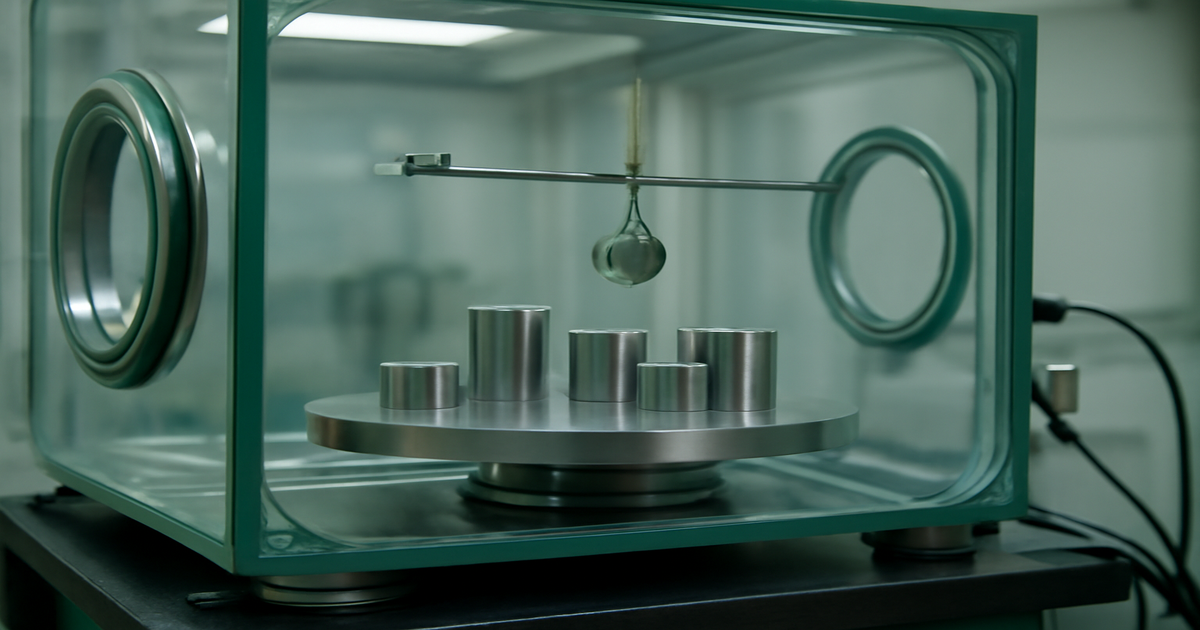
A team led by U.S. National Institute of Standards and Technology physicist Stephan Schlamminger has measured the gravitational constant, big G, at 6.67387×10⁻¹¹ m³/kg/s² — 0.0235% below the value that the International Bureau of Weights and Measures in Sèvres, France, reported in 2007. The work, which took about a decade at NIST’s campus in Gaithersburg, Maryland, was published online on April 16, 2026, in Metrologia (DOI 10.1088/1681-7575/ae570f).
The experiment was an independent reproduction of the BIPM’s precision measurement, NIST said. Its apparatus uses eight cylindrical metal masses, four on a rotating turntable and four on a disc suspended from a copper-beryllium ribbon. One measurement tracks the rotation produced by gravitational torque; a second applies voltage to electrodes to cancel that torque. The team ran the experiment with copper masses and then repeated it with sapphire, obtaining nearly identical results. The torsion balance approach traces back to Henry Cavendish’s experiment of 1798.
To guard against bias, Schlamminger asked colleague Patrick Abbott to blind the data by subtracting an undisclosed number from the mass values. The secret figure, sealed in an envelope, was revealed at 3 p.m. on July 11, 2024, in Aurora, Colorado, at the Conference on Precision Electromagnetic Measurements. An earlier attempt to unblind in 2022 was held back after the team found it had overlooked a factor related to air pressure.
Attempts to measure the gravitational constant span more than 225 years, and G remains the most poorly known of the four fundamental forces’ constants, according to NIST. Laboratory masses are roughly 500 billion trillion times smaller than the Earth, making the measurement extremely difficult, and existing values differ from one another by about one part in 10,000 — differences that recent measurements have made hard to explain as experimental error alone. Schlamminger said he hopes a following generation of scientists will take up the problem.
Listed on the paper alongside Schlamminger are L. Chao, V. Lee, C. Shakarji and A. Possolo, together with D. Newell, J. Stirling, R. Cochran and C. Speake.