NIST offers labs five squares of unidentified fabric to test fiber-sorting accuracy
NIST is distributing a research-grade test material of five fabric squares of undisclosed fiber composition so recyclers and manufacturers can check the accuracy of their fiber identification methods, free until July 30, 2026.
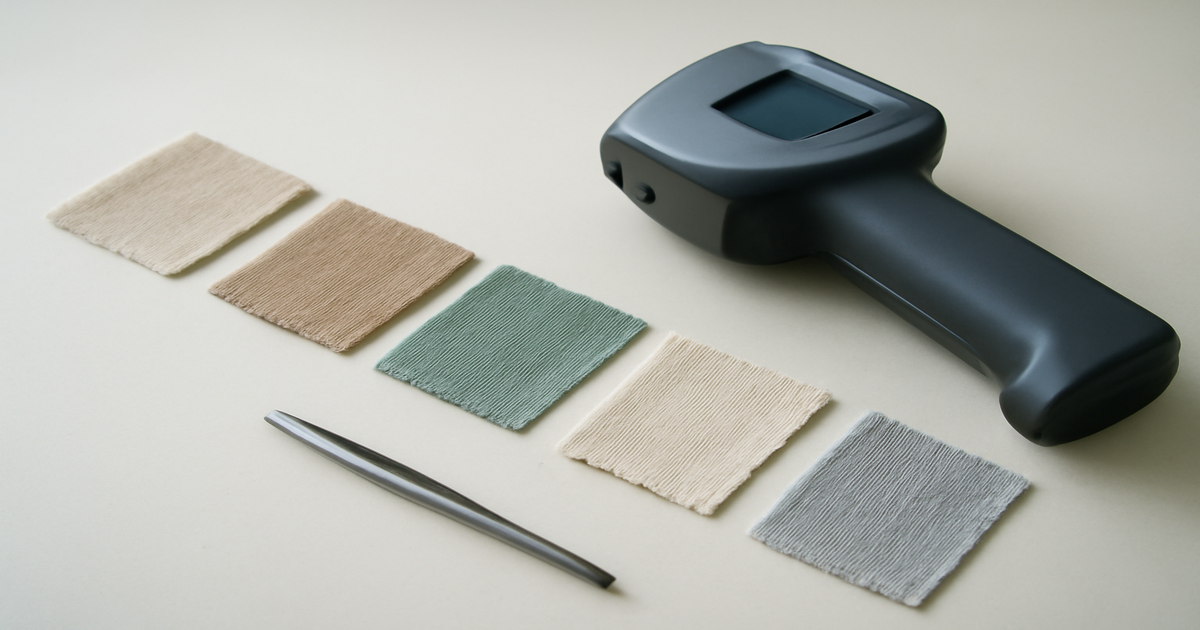
The U.S. National Institute of Standards and Technology announced on July 9, 2026, that it has developed and begun distributing a research-grade test material, RGTM 10279, for testing how accurately fibers in textiles can be identified. The material is a set of five square pieces of fabric, each four inches (10.2 centimetres) on a side, made from different fibers and including both dyed and undyed samples. It is shipped without disclosing the fiber composition.
The recycling and sorting industry can use the set to assess how accurate its sorting methods are and to validate fiber identification algorithms, NIST said. Recycling facilities currently identify fibers with handheld scanners using near-infrared spectroscopy and then sort by hand; NIR is also used in automated sorting that combines cameras and sensors on conveyor belts. Other approaches include computer vision, which sorts by colour and appearance, and hyperspectral imaging combining NIR with camera sensors.
NIST said the material can also be used to detect components not declared on labels — for example, allowing a brand to check whether fabric it bought as 100% cotton is actually a blend. The agency noted that luxury goods authentication is another possible application, although it is not an area NIST is currently researching.
More than half of clothing and textiles can be recycled but most is not reused, according to NIST, which cited the volume of donated clothing and the slow, labour-intensive nature of manual sorting as obstacles. NIST materials research engineer Amanda Forster, guest researcher Katarina Goodge and researcher Michelle Seitz were quoted on the work.
The material is available free through the NIST Store in exchange for feedback and participation in the study, with free distribution running to July 30, 2026, and the research phase ending September 30, 2026. Inquiries go to fibrils[at]nist.gov. Research-grade test materials are a relatively new category produced on a shorter timeline than NIST Standard Reference Materials and distributed to laboratories that agree to share their measurement results.
Laboratories and manufacturers are to analyse the material with their own fiber identification methods, and NIST said it will use the anonymised feedback to develop a more thoroughly characterised reference material matched to industry needs.