Webtoons turned the phone screen into Korea's most portable cultural export
The vertical-scroll comic was an accident of Korean portal design in the mid-2000s that turned out to be the native reading format for the device the world now reads on.
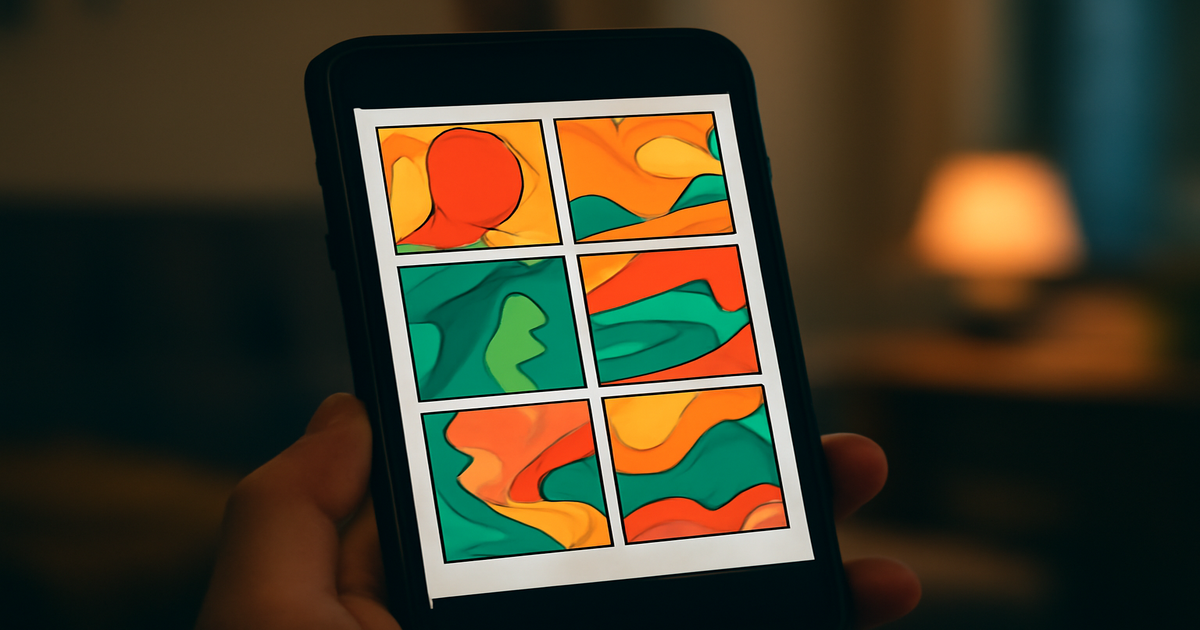
The webtoon began as a solution to a filing problem. When Korean web portals started hosting comics in the early 2000s — Daum from 2003, Naver shortly after — they were publishing into a browser window, and the browser window scrolls. Rather than reproduce printed pages as images to be clicked through, artists began composing continuously downward, with the gutter between panels stretched into vertical whitespace. Publishing housekeeping became a grammar. By the time smartphones arrived, Korean comics had spent several years learning to compose for a tall, narrow, scrolling rectangle, which is precisely the shape the rest of the world was about to hold in its hand.
The formal consequences are underrated. In a printed comic, the page is the unit of composition and the page turn is the instrument of surprise. In a vertical scroll there is no page and no turn; timing is controlled by distance, so a long empty stretch of colour functions as a pause and a sudden widening of the frame functions as a shock. Colour is standard rather than a premium, because there is no printing cost. The reader’s thumb sets the pace. These are not translations of manga or bande dessinée conventions but a separate set, and they are learnable by artists anywhere, which is part of why the format travelled.
The business model travelled with it, and may have mattered more. Korean platforms serialise daily or weekly, release the early episodes free, and sell access to what comes next through small payments or timed unlocks — the “wait and it becomes free” mechanic that trades patience against a few hundred won. This converts reading into a habit with a metered exit, and it works on audiences that will not buy a book. Naver’s webtoon service reported global monthly users in the range of 85 million around 2023, and Kakao’s Piccoma became the leading comics application in Japan by revenue, a market with the world’s most established print comics culture and no obvious need for an import.
Domestically the sector became a real industry rather than a portal feature. The Korea Creative Content Agency’s survey work put the webtoon industry’s revenue at roughly 1.8 trillion won in 2022, from a base near zero fifteen years earlier. In June 2024 the corporate parent of Naver’s webtoon business listed on Nasdaq, which is a peculiar milestone for a comic-strip section of a search portal and a fair marker of what the category became.
The second engine is adaptation. Webtoons are, from a studio’s point of view, a library of pre-tested stories with attached audience data: readership curves, comment volume, demographic skew. Titles including Itaewon Class, Sweet Home, All of Us Are Dead, D.P., Hellbound and Moving reached international audiences as series, and each success made the next rights negotiation easier. The economics are straightforward — optioning a serialised comic costs a fraction of developing an original screenplay and retires part of the risk that nobody wants the story.
The strain in the system is on the people drawing. Serialisation on a weekly cadence with fifty to eighty panels an episode is an industrial workload, and Korean webtoon production has organised around studios of assistants handling line art, colour and background, coordinated by a lead artist who carries the deadline. Surveys commissioned by the culture ministry have repeatedly found average working days well beyond ten hours and widespread musculoskeletal and mental health complaints among creators, alongside long-running disputes about revenue splits and the ownership of secondary rights — the adaptations, precisely, that generate the largest sums. Legislation and standard-contract guidance have nibbled at the problem without settling it.
What Korea exported, then, is not a set of titles. It is a reading posture, a payment rhythm and a production pipeline, all of which are now being adopted by publishers who have never sold a Korean comic.