Seoul's semi-basement homes show how flood risk follows income down the stairs
Korea's summer downpours expose a drainage system built for gentler rain and a housing stock that pushes poorer residents below street level, raising hard questions about who adaptation spending protects first.
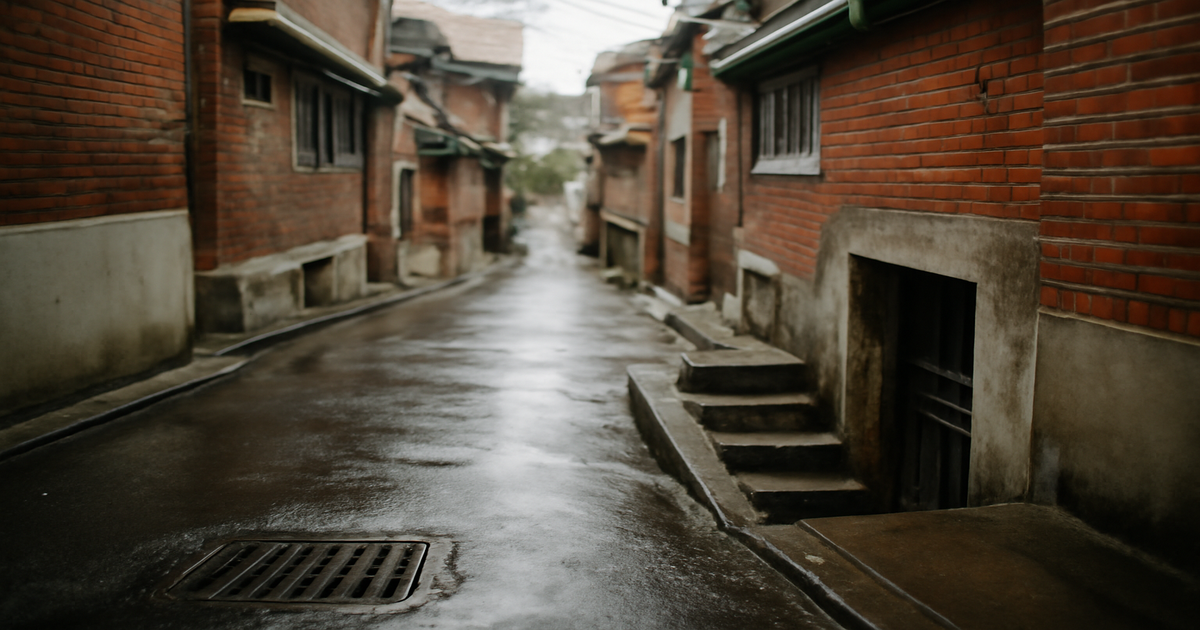
Every summer the Korean peninsula enters jangma, the monsoon season that typically arrives in late June and lingers through July. For most of modern history it has been an inconvenience rather than a catastrophe in the capital. But the character of the rain has been shifting. Instead of steady, days-long drizzle, cities increasingly face short, violent bursts that dump enormous volumes of water in a few hours. When such a storm struck Seoul in August 2022, water poured into low-lying neighborhoods faster than sewers could carry it away, and several residents drowned in their own homes. They were living in banjiha, the semi-basement apartments that sit half below the sidewalk.
The banjiha has an unusual origin. During the Cold War, amid fears of North Korean attack, building rules from around the 1970s encouraged or required basements in new low-rise residential buildings so they could serve as shelters. As Seoul’s population exploded and housing grew scarce, those spaces were gradually rented out, and regulations were later loosened to allow people to live in them legally. What began as civil defense became one of the city’s cheapest forms of housing. The film Parasite introduced global audiences to the cramped window at eye level with passing feet, but for many Seoul residents, especially elderly people, young workers, recent migrants and people with disabilities, it is simply where the rent is affordable.
That affordability is purchased with risk. A banjiha sits at precisely the elevation where floodwater collects first. When street drains back up, water does not need to rise far before it reaches window ledges and doorways, and stairs leading down become channels. Doors can be pinned shut by water pressure, and low windows are often fitted with security bars that block escape. Many banjiha cluster in older, densely built districts on hillsides and valley floors, such as parts of Gwanak and Dongjak, where narrow alleys funnel runoff downhill. Flood exposure in Seoul is therefore not random. It follows the contours of both topography and the housing market.
The drainage system compounds the problem. Seoul’s sewers and pumping stations were largely designed around historical rainfall patterns, with capacity sized for storms of a given intensity that engineers expected to recur only rarely. Decades of paving have turned former streams and paddies into impervious surfaces, so rain runs off almost instantly rather than soaking in. Even affluent areas are vulnerable: the Gangnam station basin, a natural low point, has flooded repeatedly despite its wealth. The difference is in consequences. A flooded office lobby is costly; a flooded bedroom below ground can be lethal.
The policy response has moved along two tracks. The first is engineering. Seoul has invested in deep underground storage tunnels that temporarily hold stormwater before releasing it to the Han River, and a tunnel completed in the Sinwol-dong area of western Seoul is widely credited with sparing that once flood-prone neighborhood in subsequent storms. The city has promised more such tunnels for other chronic hotspots, though they are expensive and take many years to build. The second track targets housing directly: subsidies for flood barriers at entrances, window fittings that can open from inside, alarm systems, and a stated goal of phasing out banjiha as residences altogether, with rental support for tenants who move above ground.
Each approach carries tensions. Megaprojects protect whole districts but arrive slowly, while the next storm could come any summer. Phasing out semi-basements sounds humane, yet without a sufficient supply of affordable above-ground units, displaced tenants may simply be priced into longer commutes, worse conditions or informal housing elsewhere. Landlords, meanwhile, have little incentive to retrofit units whose value lies in their low cost.
The broader lesson is that climate adaptation is never only about pipes and pumps. Where water goes in a city is shaped by engineering, but who stands in its path is shaped by income. Seoul’s challenge is to spend in a way that treats the people living half underground not as an afterthought to infrastructure planning, but as its starting point.