Korea's retirement accounts hold a fortune and earn almost nothing
Mandatory corporate retirement savings passed 380 trillion won while long-run returns hovered around two percent, because most of the money sits in principal-protected deposits that nobody ever moved.

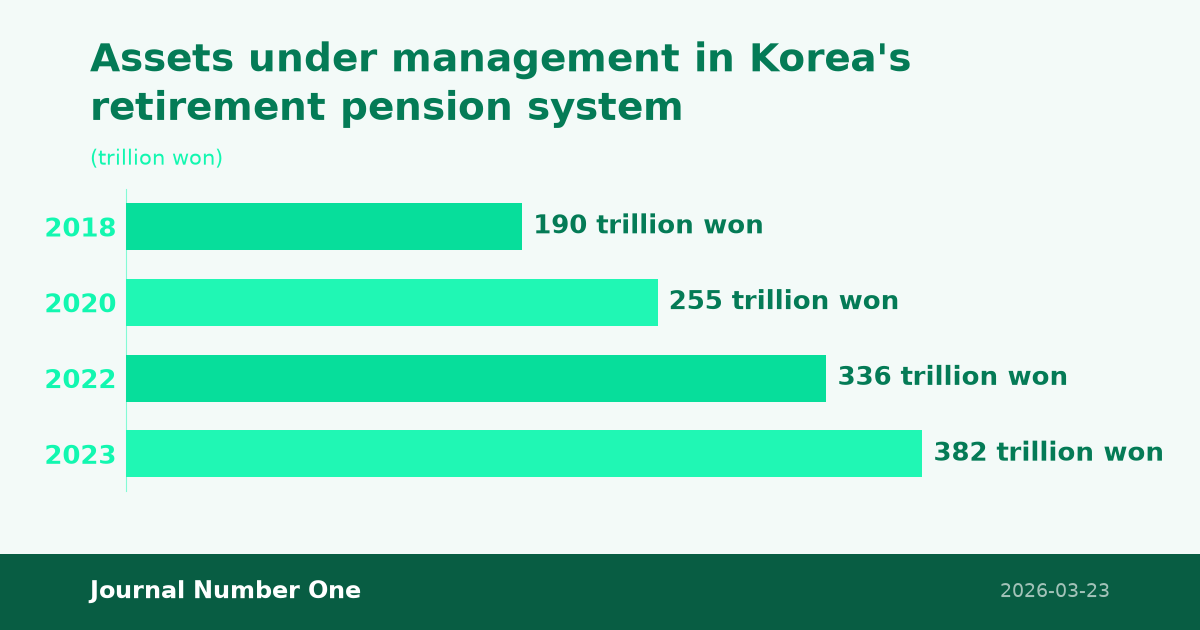
Korea’s retirement pension system, introduced in 2005 to replace the old lump-sum severance payment, is compulsory for employers and enormous in aggregate. Assets under management stood at roughly 190 trillion won at the end of 2018, passed 255 trillion won in 2020, reached about 336 trillion won in 2022 and approached 382 trillion won at the end of 2023 — a pool accumulated on behalf of essentially every regular employee in the formal sector.
Its investment performance has been poor in a specific and well-documented way. Financial Supervisory Service disclosures have repeatedly put the long-run annualised return in the region of two percent, measured over five and ten years, and in individual years the number has been worse: the 2022 return across the whole system was close to zero. Against consumer price inflation over the same span, the real return on the country’s second pillar of retirement provision has been near nothing, and in some years negative.
The explanation is not complicated. For most of the system’s history, the large majority of assets — commonly reported at around eighty to ninety percent — sat in principal-protected products: bank deposits, insurance contracts and equivalent instruments paying a rate close to short-term deposit rates. A portfolio held in one-year deposits will return roughly what one-year deposits return, and Korean deposit rates spent most of the 2010s between one and two percent. There is no mystery in the outcome; the outcome is the asset allocation.
What produced that allocation is inertia rather than choice. Defined-contribution and individual retirement pension accounts require the holder to select investments. Most holders never did, either because enrolment was handled by an employer’s administrator at hiring, or because the default in the absence of an instruction was a deposit product, or because the money felt untouchable and the interface was unpleasant. Surveys of participants have consistently found low awareness of what the accounts held. Behavioural economics has a large literature on precisely this: the default option becomes the actual option for most people, and its design matters more than the range of choices offered alongside it.
The policy response was to change the default. Legislation passed in 2021 introduced a default option — rendered in Korean as dipolteu opsyeon — which took effect through 2022 and became fully operational in 2023. Under it, participants who give no instruction have their contributions directed into a pre-approved portfolio vetted by the Ministry of Employment and Labor, spanning conservative to aggressive risk grades. The design borrowed heavily from the American qualified default investment alternative and from Australian MySuper.
Early results were mixed in an informative way. Aggregate returns improved in 2023, helped by a strong year in global equities, and the share of assets in performance-based products rose. But a large majority of default-option assets were reported to sit in the most conservative risk grades, which are themselves heavily weighted toward principal-protected instruments — the default was changed, and a great many participants defaulted again, one level down.
The stakes are not marginal, because compounding over a working life is unforgiving. Two percent nominal over thirty years roughly doubles a contribution; five percent multiplies it by more than four. On a pool approaching 400 trillion won, a sustained two-percentage-point difference is worth several trillion won a year in foregone income, and it lands on households whose public pension is modest and whose old-age poverty rate is the highest in the OECD by a wide margin. The National Pension Service, the public pillar, has by contrast earned long-run returns well above the retirement pension system’s, so the same country runs one retirement pool professionally and leaves the other in a deposit account. Whether the remedy is better defaults, mandatory professional management, or consolidation of scattered accounts into vehicles large enough to be managed seriously is argued in all three directions — and none of them changes the fact that the money is already there and has been earning very little for a long time.