Why Korea builds world-class transit but still struggles with the bicycle lane
Korea's cycling and micromobility networks remain recreational rather than functional, a gap rooted in road hierarchy, land scarcity and a transit system so good it crowds out the alternatives.
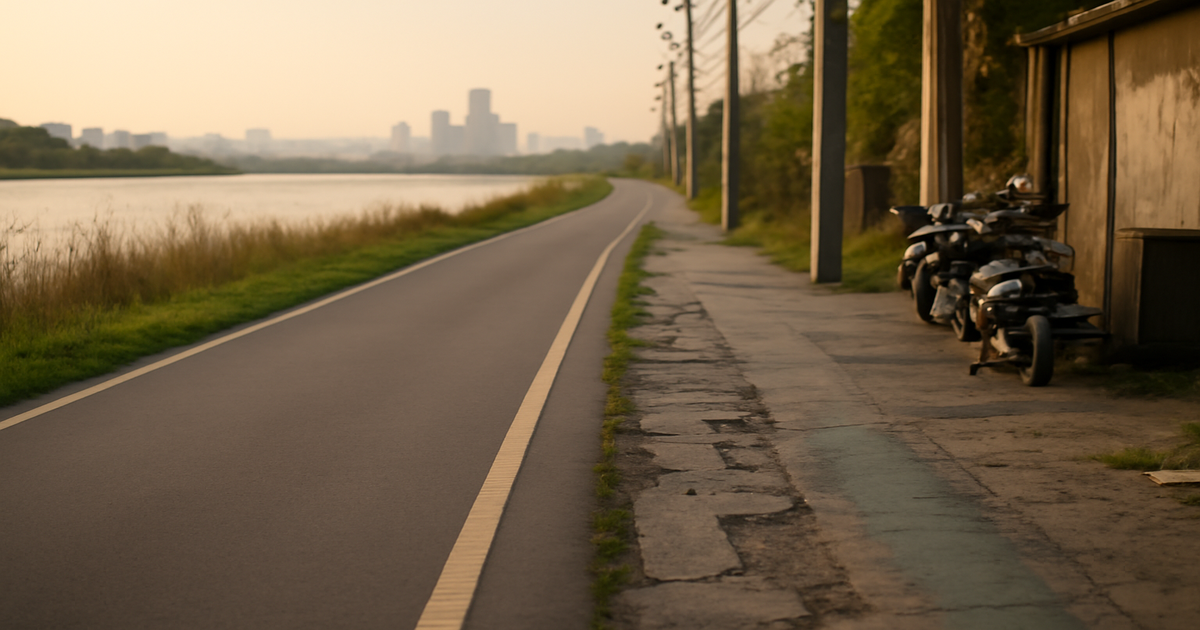
Ride along the Han River on a clear spring evening and Korea looks like a cycling country. The riverside paths are wide, continuous, well lit and genuinely pleasant, carrying thousands of riders past Yeouido and Ttukseom. Then try to leave the river. Within a few hundred meters the dedicated path dissolves into a painted strip on a sidewalk, then into a shared-use pictogram, then into nothing at all, and the rider is negotiating an eight-lane arterial with buses on the right. This discontinuity is the central fact of Korean cycling infrastructure: the country has built impressive recreational corridors along waterways and almost nothing that functions as a transport network between where people live and where they work.
The reasons begin with how Korean cities were assembled. Most of the urban fabric outside the old cores was laid down between the 1970s and 1990s as apartment superblocks separated by very wide arterial roads, a pattern that produces long blocks, few through-streets and intersections spaced far apart. That geometry is hostile to bicycles in a specific way: there is no fine-grained secondary network to ride on, only the arterial or the interior of a gated apartment complex. In Dutch and Danish cities, the bicycle succeeded largely by taking over quiet residential streets and parallel routes. Korea’s residential interiors are private, and its public streets are mostly big ones.
Space is the second constraint. Korean road rights-of-way were dimensioned for motor vehicles at a moment when car ownership was exploding, and the residual sidewalk is now doing an enormous amount of work — it holds street trees, utility boxes, bus shelters, parked delivery motorcycles, shop overflow and, in many districts, legally parked cars. Reallocating a full travel lane to bicycles means confronting a merchant constituency that treats curbside space as commercial infrastructure, and district offices have limited appetite for that fight. The result is that bicycle facilities are usually retrofitted onto the sidewalk rather than carved out of the roadway, which is cheaper, less politically costly and substantially less useful.
There is also the awkward truth that Korea’s public transport is too good for cycling to be obviously necessary. Seoul’s subway reaches nearly everywhere, integrates with buses on a single fare, runs frequently and is cheap. In cities where cycling became mainstream, it typically filled a gap left by expensive, slow or incomplete transit. In Seoul the gap is narrow — it exists mainly in the first and last kilometer, which is precisely the market that the Ttareungi bike-share system and the shared electric scooters have tried to serve. Both have found real demand, which suggests the latent appetite is there; what is missing is the safe, continuous, legible space to use them in.
Micromobility regulation has compounded the problem rather than resolved it. When the rules governing personal mobility devices were tightened in 2021 to require a driver’s license and helmet for electric scooters, the effect was to suppress ridership without producing the physical infrastructure that would have made riding safer in the first place. Enforcement fell on users; the underlying condition — riders forced to choose between an illegal sidewalk and an intimidating roadway — did not change. Sidewalk clutter from dockless scooters then generated its own backlash, and local governments responded with impoundment regimes rather than parking corrals.
None of this is immovable. Sejong was planned from the outset with a comparatively coherent bicycle network, and Changwon’s public bike system has operated since the late 2000s as a genuine transport service rather than a leisure amenity. The lesson from both is that Korean cycling works when the network is designed as continuous infrastructure rather than as recreation appended to a riverbank. Topography and weather are real obstacles in a mountainous country with a monsoon and hard winters, but electric assist has blunted the first and neither prevents cycling in Japanese or Taiwanese cities of similar climate. What has been missing is the decision to treat road space as something that can be reallocated.