Private tutoring spending keeps climbing even as Korea's student population shrinks
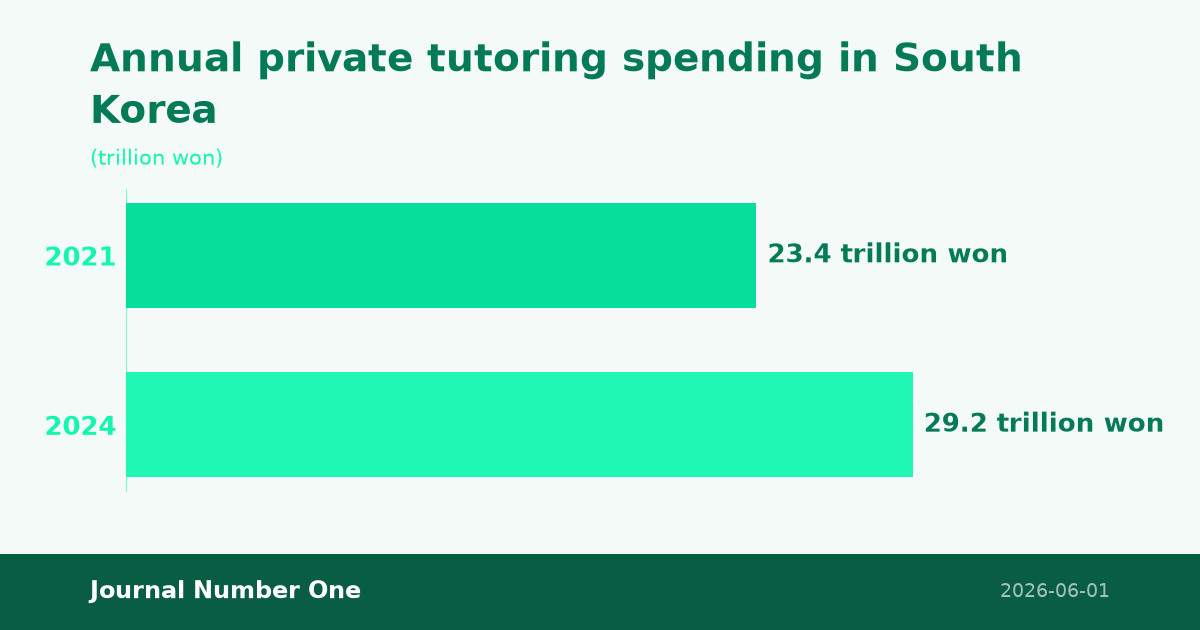
South Korea's households spent about 29 trillion won on private tutoring in 2024, a record high reached while the number of school-age children continued to fall — a paradox that says much about how education and opportunity are linked in the country.
South Korea measures its private tutoring economy every year, and the series has become one of the most closely watched indicators of social strain in the country. Total spending on hagwon — the private cram schools that operate after regular school hours — and other paid tutoring reached about 29.2 trillion won in 2024, according to the annual survey conducted by Statistics Korea with the education ministry. That followed roughly 27.1 trillion won in 2023, 26 trillion won in 2022 and 23.4 trillion won in 2021.
What makes the series remarkable is the denominator. The number of primary and secondary students has been falling for years, to roughly 5.2 million, as the country’s low birth rate works its way through the school system. Fewer children, more spending: the arithmetic means that spending per child has risen faster than the headline total, with monthly outlays per participating student approaching half a million won in the 2024 survey. Around eight in ten students take part in some form of paid tutoring.
The persistence of hagwon spending is usually explained by competition for university places, but that explanation has grown less complete over time. University seats are no longer scarce in aggregate — many institutions outside the capital region struggle to fill them. What remains scarce is a place at the handful of universities that feed the most secure careers, and entry to those is decided largely by the national college entrance exam and a school record built up over years. Families that can afford to buy an edge do so early, and families that cannot often stretch to keep up.
The result is an education arms race with well-documented side effects. Household surveys consistently rank education costs among the main financial pressures on families with children, alongside housing, and researchers studying the country’s fertility decline regularly cite the anticipated cost of raising and educating a child as a reason young couples delay or forgo parenthood. In that sense the tutoring ledger is not only an education statistic; it is part of the demographic story.
Governments of both parties have tried to bend the curve, through curfews on hagwon operating hours, expanded after-school programmes at public schools, and periodic pledges to remove so-called killer questions from the entrance exam so that test preparation depends less on paid coaching. The spending series suggests these measures have at most slowed the growth. As long as the labour market rewards a narrow set of credentials so heavily, demand finds a way around each restriction.
For international readers, the figure is worth keeping in view because it prices a social norm. Nearly 30 trillion won a year is roughly what a mid-sized country spends on its entire public school system, and Korean families pay it on top of one of the developed world’s more capable public systems — not because the schools fail, but because the competition sits above them.