Korean apartments get torn down young, and the arithmetic explains why
Korea's reconstruction cycle demolishes apartment complexes decades before they are structurally spent, because the value lies in unused development rights — and the resulting windfalls are distributed very unevenly.
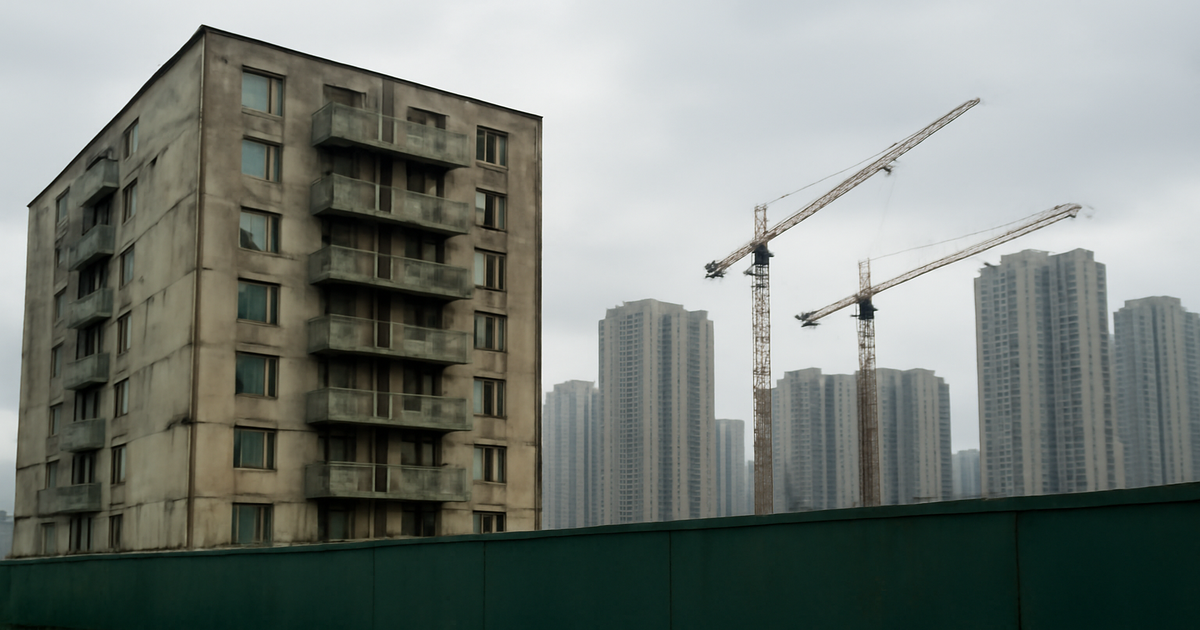
A concrete apartment building can stand for a century with maintenance. In Korea, many are gone before their fiftieth birthday, and the reason is rarely that they are falling down. It is that the land beneath them is worth more than the structure on top, and the gap widens every year that the surrounding city intensifies. A five-story complex built in the 1970s on generous grounds in southern Seoul, or a fifteen-story estate from the late 1980s in one of the first-generation new towns, sits on a plot zoned to permit far more floor area than it currently uses. That unused entitlement is the asset. The buildings are, in the logic of the market, an obstacle to it.
The legal machinery for converting entitlement into cash is elaborate. A complex generally becomes eligible for reconstruction at around thirty years of age, after which it must pass a safety diagnosis — a step that successive governments have loosened or tightened depending on whether they wanted to stimulate supply or cool prices. Owners then form an association, which is a legal entity with elected officers, and select a contractor from among the large builders whose apartment brands function as consumer labels. Approvals for the management disposal plan follow, then relocation, demolition, construction and occupancy. Between the first informal meeting and the first move-in, a decade is unremarkable and two decades not unusual. Some famous Gangnam complexes have been discussing reconstruction for most of the adult lives of their residents.
The money works like this. If the rebuilt complex contains more units than the old one, the surplus is sold on the open market, and those proceeds offset the cost of building replacement homes for existing owners. In a rising market with a generous floor area ratio, owners can receive a brand-new, larger apartment for little or no cash outlay — the celebrated “free reconstruction.” When construction costs rise or the permitted density is stingy, the same owners face contribution demands running to hundreds of millions of won. That reversal is why disputes between associations and contractors over cost escalation have become a routine feature of the sector, and why projects stall midway with residents already relocated and paying interest on relocation loans.
The beneficiaries are easy to name. Owners who bought early capture the largest share, since the expectation of reconstruction is priced into the unit long before a single wall comes down; a decrepit apartment with good entitlement trades at a premium precisely because it is decrepit. Large builders secure a pipeline of work in a city with almost no vacant land, and charge for the brand. Banks earn on relocation and bridge lending. A supporting industry of redevelopment consultants, appraisers, law firms and agents takes a cut at each procedural stage. The state recaptures a portion through a levy on excess reconstruction gains, though the levy has been repeatedly deferred, diluted and litigated.
The losers are harder to see because they leave. Tenants hold no membership in the association and no claim on the new units; they receive limited relocation support and must find housing elsewhere, usually at higher rent, in a neighborhood where several hundred households have just been pushed into the rental market at once. Small owners who cannot fund their contribution are bought out in cash settlement and effectively priced out of the district they helped make valuable. Elderly owners on fixed incomes face the same squeeze from the opposite direction.
What holds the system together is an expectation of permanently rising prices, since every actor’s payoff depends on the new apartments selling for substantially more than the old ones cost to replace. With the first-generation new towns of the 1990s now reaching the age of eligibility more or less simultaneously, that assumption is about to be tested at scale.