The hidden bill behind Korea's cheap electricity
Korean households pay some of the lowest electricity prices in the developed world, and the state utility has absorbed the difference as debt large enough to constrain the grid investment the country now needs.
Electricity in South Korea is unusually cheap for a country that imports nearly all of its fuel. International Energy Agency comparisons have consistently placed Korean household tariffs among the lowest in the OECD, below Japan and far below most of western Europe. That outcome is not a matter of resource endowment or technology. It is a pricing decision, taken and re-taken by the government, and its cost has accumulated on one balance sheet.
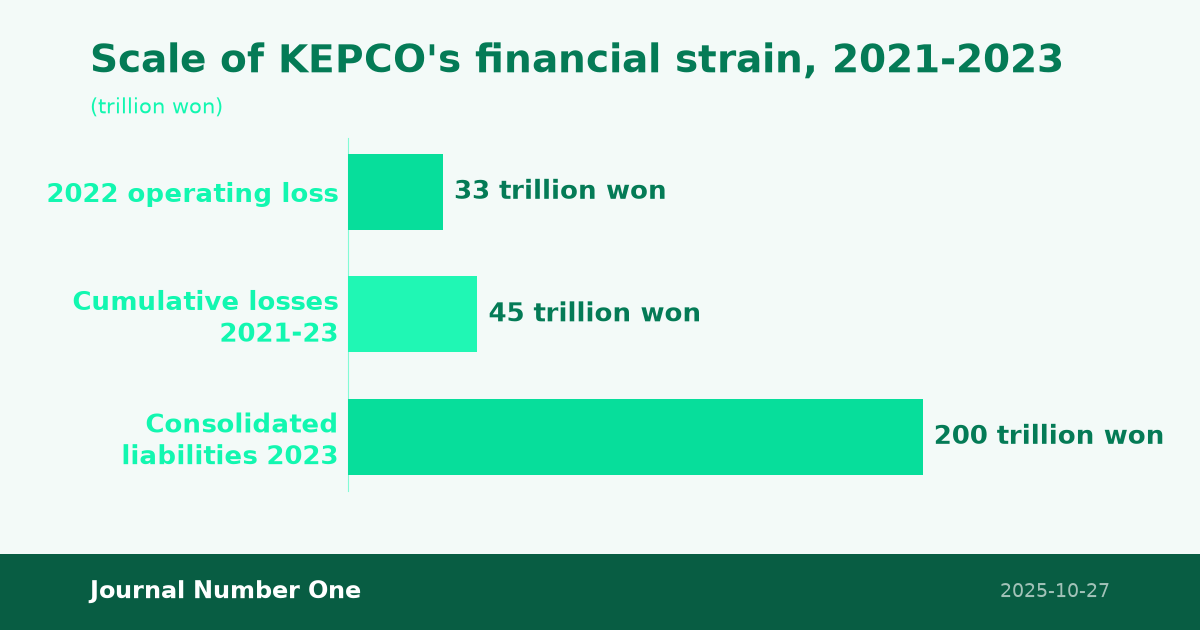
The mechanism runs through Korea Electric Power Corporation, the state-controlled utility that buys almost all generated power through a wholesale settlement system and sells it to end users at retail tariffs that require government approval. When fuel prices rise, KEPCO’s purchase costs rise immediately, while the tariff does not move unless it is authorised to. Between 2021 and 2023, as coal and liquefied natural gas prices surged following the energy shock, that gap became extraordinary: KEPCO reported an operating loss of roughly 33 trillion won in 2022 alone and further heavy losses in 2023, with cumulative losses over the three-year period in the region of 45 trillion won.
Those losses were financed with borrowing. KEPCO’s consolidated liabilities rose above 200 trillion won by 2023, and the company issued corporate bonds in volumes large enough to distort the domestic bond market — at the peak, its issuance was widely blamed for crowding out other Korean borrowers and pushing up corporate funding costs generally. Interest payments alone came to several trillion won a year, which is to say that a policy of holding down household bills was being funded at market interest rates by an entity whose only revenue is those bills.
Tariffs did eventually rise, in stages from 2022 through 2023, cumulatively by a substantial margin. But the increases were distributed unevenly: industrial users, particularly large ones, absorbed the steepest rises, while residential rates were raised more cautiously and then held flat for extended stretches while consumer price inflation was the dominant policy concern. The political logic is straightforward — electricity is a highly visible price and enters the inflation basket directly — but the effect is to sever the link between what power costs to produce and what using it costs.
Suppressed prices carry two costs beyond the accounting one. The first is on the demand side: with no price signal, there is weak incentive to insulate buildings, replace inefficient equipment or shift consumption away from peak hours, and Korea’s electricity intensity per unit of output remains high by advanced-economy standards. The second is on the supply side, and it is becoming the binding one. Connecting large volumes of solar and wind capacity, building long-distance transmission from generation sites to the industrial and data-centre demand concentrated near Seoul, and reinforcing distribution networks all require sustained capital spending from a company whose credit capacity has been consumed by operating losses.
The result is a familiar pattern in administered pricing: the bill is not cancelled, only deferred and reassigned. It surfaces as utility debt, as higher borrowing costs across the corporate bond market, as delayed grid projects, and eventually as tariff increases that arrive later and in larger increments than gradual adjustment would have required. Ratepayers and taxpayers are largely the same people, so the question is not whether the cost is paid but when, and through which channel.
Korea is not alone in this — administered energy pricing is common, and several European governments ran comparable schemes through the same shock. What distinguishes the Korean case is the concentration of the whole adjustment inside a single listed state utility, which makes the accumulated cost unusually easy to measure and unusually hard to spread.