Why Korea argues so much about its inheritance tax
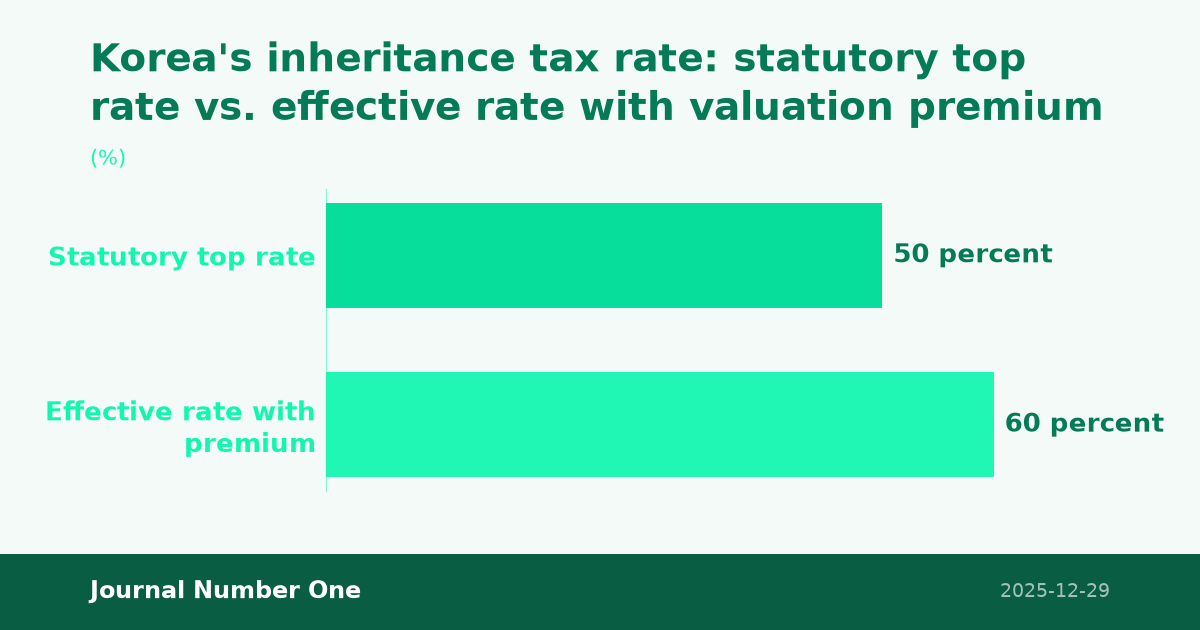
Korea's top statutory inheritance tax rate of 50 percent is among the highest in the OECD, yet fewer than one estate in fourteen pays anything at all, and both facts are used as arguments.

Korea taxes inheritance at a top statutory rate of 50 percent on estates above three billion won, second only to Japan among OECD members and far above the many countries — Canada, Australia, Sweden among them — that levy no inheritance or estate tax at all. For shares in a company transferred by a controlling shareholder, a valuation premium of up to 20 percent applies, which is how the frequently cited effective figure of 60 percent arises. Those numbers do most of the work in the public argument, and taken alone they are misleading in both directions.
They overstate the burden because the tax as administered is narrow. A spouse’s deduction can reach three billion won, a lump-sum deduction of 500 million won is available in the alternative to itemised allowances, and further deductions apply to financial assets and to the family home. National Tax Service statistics have consistently shown that only a small minority of deaths — well under one in ten, and by some years’ figures closer to one in twenty — result in any inheritance tax liability. Combined inheritance and gift tax revenue has run in the range of 14 to 15 trillion won a year, a low single-digit percentage of total national tax receipts.
They understate a different problem, which is that the thresholds have barely moved. The basic deduction amounts date largely from 2000, while apartment prices in Seoul have multiplied several times over since. An estate consisting of one ordinary apartment in the capital can now exceed thresholds designed for what was then plainly a wealthy household. The share of estates paying has risen steadily without any rate being raised, through asset price inflation alone — bracket creep that has moved the argument from the very rich toward the merely propertied.
For businesses the issue is control rather than cash. A founder’s stake passed to heirs at a 50 percent rate, with a valuation premium on top, generally cannot be paid from liquid assets, so heirs sell shares, borrow against them, or use the instalment arrangements the law permits over a period of years. Each route dilutes or encumbers the family’s holding. Korea offers a family business succession deduction — expanded in 2023 to cover substantial estate values — but it carries employment maintenance, business continuity and shareholding conditions lasting years, and take-up has remained modest, with only a few hundred cases annually. Small and medium manufacturers argue that this is why succession often ends in a sale to a fund rather than a transfer to a child.
At the top of the corporate structure the same tax has shaped ownership itself. Korean conglomerates historically maintained control through cross-shareholdings and holding company structures that could be inherited more cheaply than direct stakes. Reforms unwinding circular ownership removed some of those devices, leaving large succession liabilities to be settled openly — the estate of one major group chairman in 2020 generated a tax bill reported at around 12 trillion won, payable in instalments over five years and financed partly through share disposals and borrowing.
The reform proposals in circulation have consequently split along that line. The finance ministry has studied a shift from taxing the estate as a whole to taxing what each heir actually receives, the standard approach in most OECD countries with such a tax, which would lower burdens on divided estates without cutting headline rates. Others have argued for raising the deduction thresholds to reflect three decades of asset inflation, or for cutting the top rate outright on competitiveness grounds.
Against all of this sits the equity argument, which has not weakened. Korean wealth is heavily concentrated in property, intergenerational transfers are a documented driver of that concentration, and inheritance taxation is one of the few instruments that reaches accumulated assets directly. Any reform that narrows it therefore has to answer what replaces it.