Smart farms are being asked to replace a generation of farmers
With the average Korean farmer approaching seventy and few successors in sight, the state is betting that sensors, glasshouses and vertical racks can substitute capital for the people who are not coming.
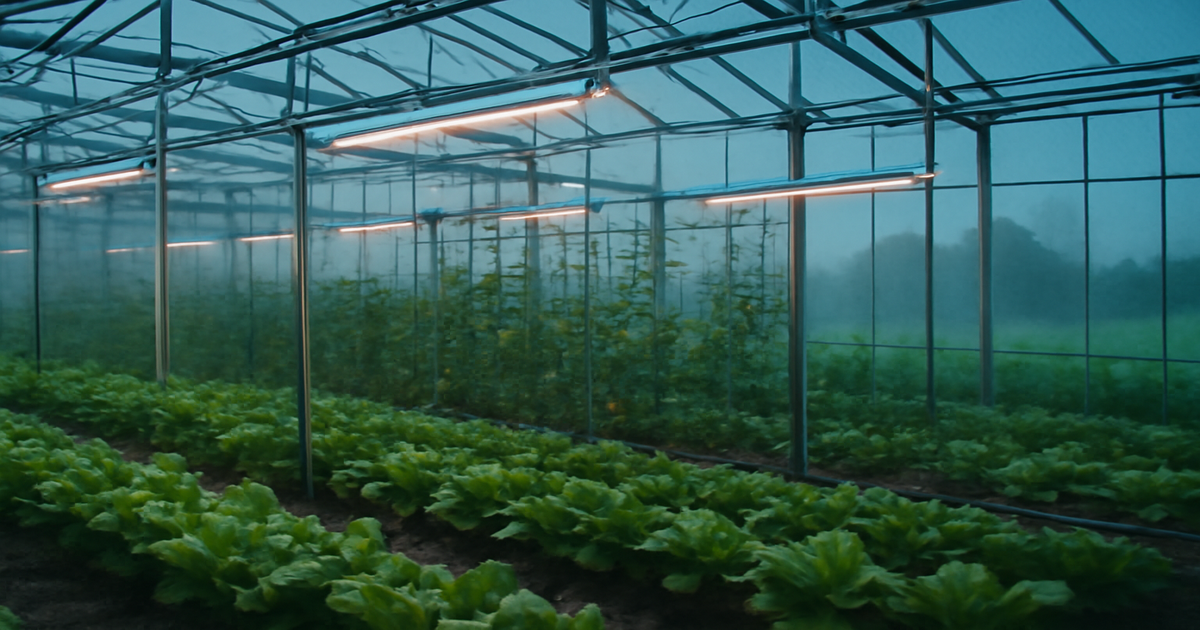
The demographic facts of Korean agriculture are stark enough that they function as the policy. The farming population has fallen to roughly two million people, from more than ten million in the 1970s, and the age structure has inverted: Statistics Korea’s agricultural surveys have put the average age of a farm household head at around sixty-eight, with close to half aged sixty-five or over. In a growing number of rural townships the youngest working farmer is in their fifties. The question facing Korean agriculture is not how to raise productivity in the abstract; it is what happens to the land when the current cohort stops.
The state’s answer has been to industrialise the parts of farming that can be industrialised. Smart farms — glasshouses and controlled-environment facilities in which temperature, humidity, carbon dioxide, irrigation and nutrient dosing are regulated by sensors and software — have been the centrepiece of agricultural policy for the better part of a decade. Government programmes have subsidised retrofitting existing greenhouses with environmental controls, and purpose-built complexes branded smart farm innovation valleys were developed in Gyeongbuk, Jeonbuk, Jeonnam and Gyeongnam to combine production, training and start-up incubation in one location. The training component is the tell: the valleys exist as much to manufacture farmers as to manufacture vegetables.
The technology works best on a narrow set of crops, and the narrowness is not a temporary limitation. Controlled environments earn their capital cost on high-value, fast-cycling, light-tolerant produce: strawberries, tomatoes, paprika, and leafy greens. Vertical farms, which stack growing trays under LED arrays and dispense with sunlight altogether, are viable on an even shorter list — mostly salad leaves and herbs with growth cycles measured in weeks. Rice, which occupies more than half of Korea’s cultivated area and carries most of its political weight, is not a smart-farm crop and will not become one. The substitution of capital for labour is therefore partial by construction.
The economics are demanding. A commercial-grade smart greenhouse costs on the order of hundreds of millions of won per hectare to build, and a vertical farm considerably more per unit of output, with electricity for lighting and climate control as the dominant recurring cost. That is a hard equation in a country whose electricity prices have been rising and whose retail vegetable prices, while volatile, are not high enough to absorb an arbitrary cost base. Several Korean vertical-farming ventures that scaled quickly in the low-interest years of 2020 and 2021 subsequently retrenched, and well-funded American and European operators that entered insolvency in 2023 and 2024 demonstrated publicly that the model is not automatically profitable at scale.
There is also a distributional problem inside the policy. The farmers most able to finance a smart facility are those with land, collateral and successors — that is, the households least at risk of disappearing. The elderly smallholder farming a hectare of paddy in a depopulating county is not a candidate for a controlled-environment retrofit, and the innovation valleys, which recruit younger entrants without farming backgrounds, effectively concede this by building a parallel supply of farmers rather than upgrading the existing one. Whether that supply stays is the unresolved part: retention data on programme graduates is thinner than enrolment data, and rural depopulation is driven by schools, clinics and jobs for spouses at least as much as by farm returns.
What smart farming does deliver is real. Yields per unit area in a well-run controlled environment are multiples of open-field yields; water use falls sharply; and the work is lighter and more schedulable, which matters for an ageing workforce and for attracting anyone under forty. Import substitution in winter vegetables and stability of supply through erratic summers are genuine gains.
But the framing that treats technology as the successor to a generation deserves scepticism. Software can run a glasshouse. It cannot keep a village school open, and the land that will actually go out of production over the next fifteen years is mostly not under glass.