Korea's fish farms grew as the wild catch shrank, reshaping coastal work
As overfishing and warming seas thinned Korea's wild catch, aquaculture became the country's main source of seafood — a shift that stabilized supply while narrowing what coastal households can do for a living.
The disappearance of pollack from the East Sea is the story Koreans tell most often about their fisheries, and it works as shorthand for a broader change. A fish that once anchored winter markets and an entire vocabulary of preparations — fresh, half-dried, frozen, dried to a board — effectively vanished from domestic waters over a generation, a casualty of some combination of overfishing juvenile stock and a warming, shifting current system. It was not an isolated case. Across the peninsula’s three seas, the composition of the wild catch has drifted, with warm-water species moving north into grounds where cold-water species used to dominate, and the total haul from coastal waters trending down from its late-twentieth-century peaks.
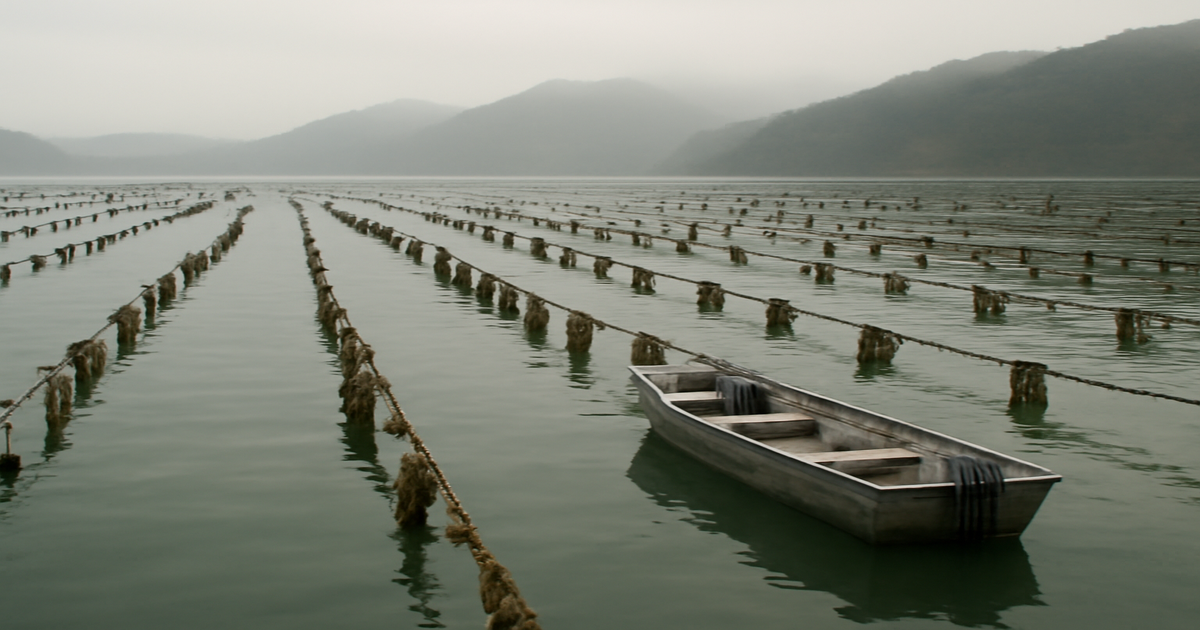
Aquaculture filled the gap, and it did so faster in Korea than the public conversation registered. Today the majority of seafood by weight that Korea produces domestically comes from farming rather than capture, and the bulk of that tonnage is seaweed — laver, sea mustard, kelp — grown on ropes and nets in the shallow bays of the southwest coast. Shellfish follow: oysters strung on longlines around Tongyeong, abalone in cages off Wando, mussels and sea squirt elsewhere. Finfish are a smaller share of volume but a large share of value, dominated by olive flounder raised in flow-through land tanks on Jeju and the southern coast, along with sea bream and rockfish in coastal net pens.
The economics that drove the shift are straightforward. A capture fisher faces a stock he does not control, competition from other boats including foreign vessels in disputed grounds, rising fuel costs and a licensing regime that caps effort. A farmer with a lease over a patch of water faces a production problem instead — seed, feed, disease, harvest timing — and can plan against a contract. For a coastal household, that is a different relationship to risk, and for the state it is a different relationship to supply. Korea imports a great deal of seafood and consumes fish at rates high by global standards; farmed production is the part of the supply chain that policy can actually schedule.
What that has meant for coastal livelihoods is more ambiguous than the production figures suggest. Aquaculture leases are allocated through a licensing system in which village fishery cooperatives hold collective rights to nearshore grounds, which in principle keeps benefits local. In practice the capital requirements have risen — cages, feed, pumps, boats, cold chain — and the villages themselves have aged severely, with young successors scarce enough that farms increasingly depend on migrant labor from Southeast Asia. The work has also narrowed. A seaweed operation is a schedule, not a search; it produces steady income and very little of the autonomy that made fishing an identity rather than a job.
The environmental exposure has simply changed form. Farms concentrated in warm shallow bays are vulnerable to exactly the heat that is reshaping the wild stocks, and summer mass mortality events in flounder and abalone operations have become a recurring feature rather than a shock. Red tides, freshwater intrusion after heavy rain, and disease moving through dense stock all hit assets the farmer has already paid for. Insurance schemes and government compensation exist, but they socialize losses rather than prevent them.
The policy response has leaned toward technology and value: recirculating and land-based systems that control temperature, smart-farm sensor packages, breeding programs for heat-tolerant strains, and an aggressive push on processed seaweed exports, where Korean laver snacks have found markets far beyond the diaspora. Each of these favors larger, better-capitalized operators, which is the quiet trade-off. Korea has secured its seafood supply more reliably than most countries with similar consumption levels. Whether the coastal villages that supply it remain places where people live, rather than sites where production happens, is a separate question, and it is not one aquaculture answers on its own.