Korean research runs on graduate students paid like students
Most of the country's laboratory output is produced by graduate researchers whose income comes from the same project grants that were cut sharply for 2024, exposing how little separates a research workforce from a student body.

The bench work behind Korean science is done overwhelmingly by graduate students. In science and engineering departments, masters and doctoral candidates run the experiments, maintain the instruments, write the first drafts and train the incoming cohort, and they are paid out of the same competitive project grants that buy the reagents. Their income is not a salary set against a job description; it is a line item in a proposal, sized by what the principal investigator won and by what the university’s overhead rules leave behind. This arrangement is not unique to Korea. What is distinctive is how completely the national research system depends on it, and how directly a change in the government’s research budget lands on individual living expenses.
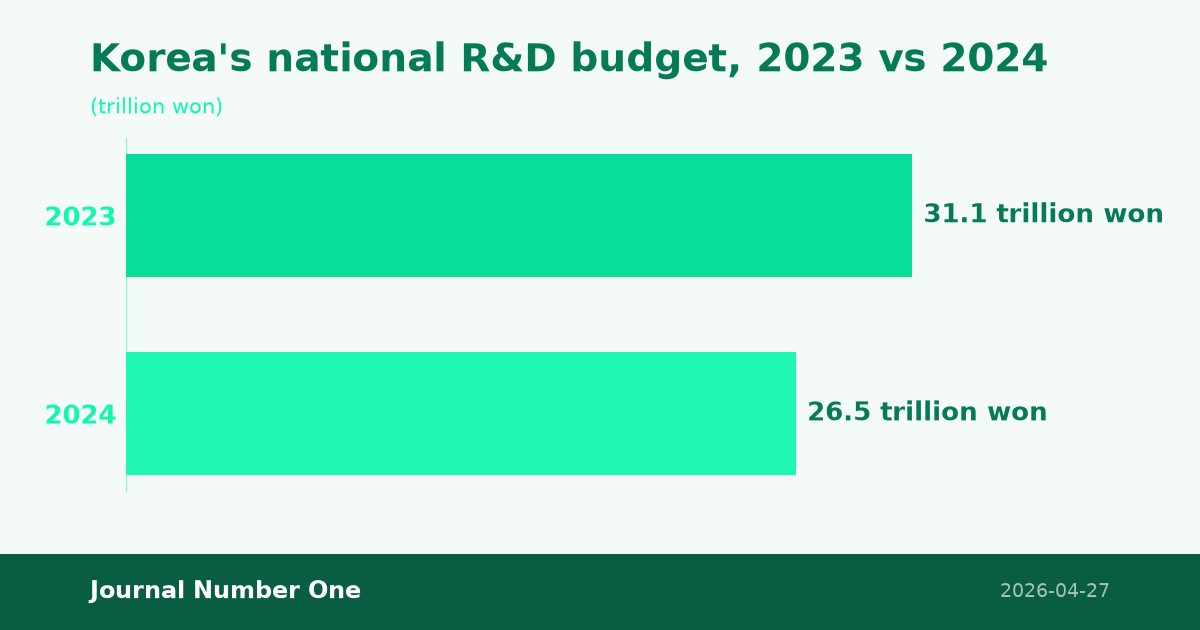
That link was demonstrated in 2024. The government’s research and development budget for the year was set at roughly 26.5 trillion won, down from about 31.1 trillion won in 2023, a reduction near fifteen percent and the first outright cut in decades. The stated purpose was to eliminate duplicated and low-value programmes. The transmission mechanism was indiscriminate: grants already running were rescoped mid-project, and the fastest adjustment available to a laboratory facing a smaller award is to reduce the number of funded students or the amount each receives. Reports of stipends being trimmed or positions left unfilled circulated through 2024, and the following year’s budget restored the total to roughly 29.6 trillion won, which repaired the aggregate without repairing the cohort that had already made decisions.
The policy response addressed the structural weakness the episode revealed. A research stipend scheme — the 연구생활장려금, generally rendered as a research living allowance — was introduced to guarantee a floor for graduate researchers regardless of the fortunes of any single grant, set at monthly minimums in the region of eight hundred thousand won for masters candidates and a little over one million won for doctoral candidates, pooled at institutional level rather than left to individual projects. The design is sound in principle: it converts part of the payment from a project variable into a standing obligation. The figures are also, plainly, floors rather than wages, and in Seoul they do not cover rent and living costs without other income.
Underneath the money sits an unresolved question about what a graduate researcher is. Korean law and practice have treated them as students with scholarship income rather than as employees, which keeps them outside most employment protections while their working hours, supervision and output are those of staff. Some of the gap has been closed at the edges — student researchers were brought within industrial accident coverage, and universities have written norms on working hours and harassment — but the underlying ambiguity persists, and it is what allows a funding shock to translate into a personal income shock with no intervening buffer.
The recruitment consequences are visible in enrolment. Domestic applications to science and engineering graduate programmes have been soft, and a growing share of masters and doctoral places, particularly outside the top few universities, is filled by international students. Departments describe this as internationalization; the enrolment pattern suggests it is also substitution. The competing destinations for a strong Korean undergraduate are a corporate research laboratory that pays several times a stipend from the first year, a doctorate abroad, or the professional track that has drawn away a large share of top science-track school leavers for two decades.
Brain drain is the usual frame and it is too narrow. Researchers leaving for better-resourced systems is an ordinary feature of an open scientific economy, and Korea has always sent people out and taken people back. The problem the 2024 cut exposed is nearer and duller: a national research capability whose labour supply is financed year to year out of discretionary grants, so that a single budget decision reaches all the way down to whether a twenty-seven-year-old can pay rent while finishing a thesis.