Korea's AI ambitions are running into its transmission lines
Data-centre power demand is concentrating in the capital region while generation and grid capacity sit elsewhere, turning the constraint on Korean AI infrastructure into a question of where wires can be built.
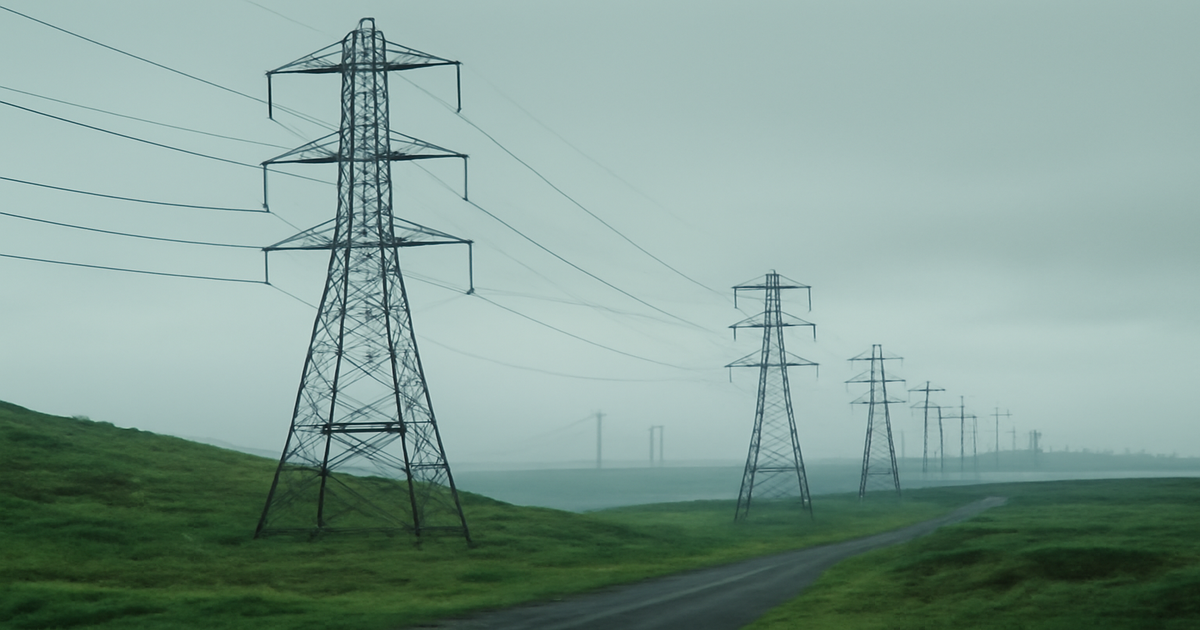
The physical requirement behind AI infrastructure is simple to state. A data hall running dense accelerator racks draws power continuously at a density several times that of the enterprise facilities Korea built through the 2010s, and it must be connected to a grid able to deliver that power reliably at a specific location. Korea’s difficulty is not that it lacks generation. It is that the demand wants to appear where the supply is not.
The concentration is stark and long-standing. Korean data centres cluster in Seoul and the surrounding Gyeonggi province, close to the network exchanges, the customers and the engineers, and grid-connection applications for new facilities have run overwhelmingly to capital-region locations — utility figures reported through the mid-2020s put the share of applied capacity there around four fifths. Generation, by contrast, is coastal and provincial: nuclear and coal on the southeastern and western seaboards, and the large wind and solar build-out along the east coast and in the southwest. Moving that power to Gyeonggi requires transmission, and transmission is the part of the system that has been late for a decade.
The east coast to capital region high-voltage link is the emblematic case, repeatedly rescheduled against local opposition and land acquisition, with east coast generation running below capacity in the interim because the wires to carry its output were not finished. Resistance to overhead lines and substations is entrenched, informed by the long dispute over towers in Miryang, and it is not irrational: the residents who host the corridor receive the disamenity and none of the electricity. Korea’s legislative answer, a special act to accelerate grid expansion enacted in 2025, streamlines approvals and strengthens compensation. It changes the process, not the years a 345-kilovolt corridor takes to build.
Demand planning has been trying to catch up. The successive Basic Plans for Long-term Electricity Supply and Demand have progressively raised projected peak load to account for data centres and semiconductor fabrication, with the eleventh plan’s outlook carrying peak demand toward roughly 130 gigawatts by the late 2030s and adding nuclear capacity accordingly. The Yongin semiconductor cluster alone is expected to need power on the order of ten gigawatts at full build, which is a national-scale requirement arriving at a single site. AI data centres sit on top of that, and their forecasts are the least reliable input in the plan, because nobody knows how much inference capacity the market will actually buy.
Policy has therefore turned toward moving the load rather than only the power. The Distributed Energy Act, passed in 2023 and effective from 2024, creates the legal basis for regional differentiation in electricity pricing and for requiring large consumers to consider siting near generation, and provincial governments on the coasts have marketed cheap, available grid capacity to data-centre developers. The obstacle is latency and staffing rather than economics for a large share of workloads: interactive services want to be near users. Training runs and batch inference do not, and that is the segment most plausibly relocatable.
Two constraints get less attention than they deserve. Cooling at accelerator densities pushes facilities toward liquid systems, which changes water requirements at a time when regional water allocation is already contested. And siting operates at street level: proposed urban data centres have met organized neighbourhood opposition over heat, noise and transformer proximity, and municipalities have responded with stricter zoning conditions. The fire at a Pangyo facility in October 2022, which took major national services offline for days, left a durable public association between data centres and risk.
None of this is an argument that Korea cannot build AI infrastructure. It is an argument that the binding constraint is neither chips nor capital but interconnection queues and rights of way — and that those are decided by land, local consent and construction schedules, on timelines much longer than the technology cycle they are meant to serve.