How noise between floors became one of Korea's most intractable neighborly conflicts
In a country where most households live stacked in apartment towers, complaints about footsteps overhead have outgrown the legal framework designed to settle them — largely because the noise that upsets people most is rarely loud enough to violate any rule.
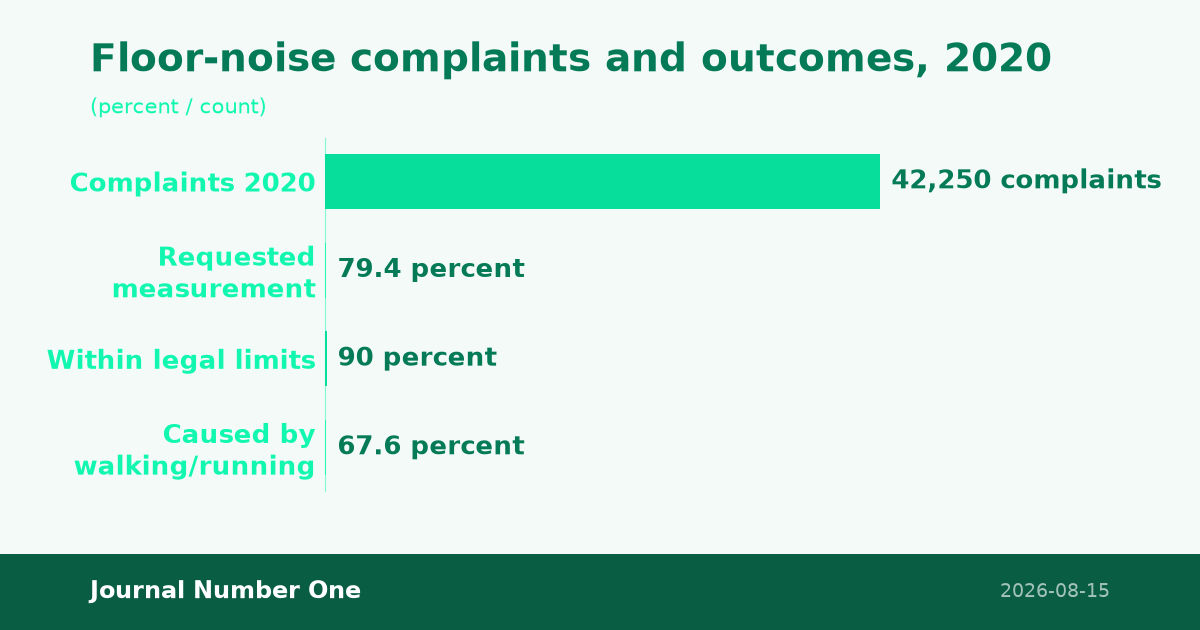
The defining statistic in Korea’s floor-noise problem is not how many people complain but how few of those complaints turn out to be illegal. According to the Statistical Research Institute of Statistics Korea, in its Korean Social Trends 2021 report, the government’s Floor Noise Neighbor Center took in 42,250 complaints in 2020, roughly 1.6 times the previous year’s total. Of those complainants, 79.4 percent asked for an on-site diagnosis or measurement — and when technicians came out with equipment, more than 90 percent of the measured cases fell within legal noise limits. That gap is the whole story: the sound is real, the suffering is real, and the law almost never agrees.
Part of the explanation is architectural. Korea urbanized through the apartment tower, and the dominant construction method for decades has been the bearing-wall system, in which floor slabs rest directly on load-bearing walls rather than on a beam-and-column frame. Impact energy from a heel strike travels through the slab into the walls and radiates into the unit below as a dull, structural thud rather than an airborne sound that a closed window can block. Ondol underfloor heating adds another layer of complication, since the slab is a heated surface that residents sit, eat and sleep on. Korean domestic life is conducted low to the ground, which means the ear is nearer the transmitting surface than in a chair-and-carpet culture.
The sources of the noise are mundane, which is precisely why they are hard to negotiate away. The same 2021 Korean Social Trends analysis found that 67.6 percent of reported floor-noise incidents involved the sound of running or walking. Not parties, not renovations, not instruments — footsteps. A household cannot promise to stop walking. This is where the dispute stops being technical and becomes moral: the complainant hears carelessness, and the family upstairs hears an accusation aimed at their children. Because the offending behavior is ordinary living, each side can plausibly regard itself as the reasonable party.
Korea’s regulatory instruments were built for a different kind of noise. The environmental standards published through the government’s national indicator system, updated for 2023 by the Ministry of Environment, set roadside residential limits of 65 decibels during the day and 55 decibels at night — thresholds designed around traffic, construction and other outdoor sources measured over time. Inter-floor impact noise required its own separate rules, and enforcement has historically depended on standards for newly built housing, meaning the millions of apartments completed in earlier decades were effectively grandfathered in. Regulators have since moved toward verifying performance in finished buildings rather than trusting pre-construction lab tests, but that reform does nothing for existing stock.
What remains for residents is mediation, and mediation depends on goodwill that has often already evaporated by the time anyone files. The Neighbor Center offers phone counseling, measurement and shuttle diplomacy; environmental dispute commissions can award damages, but the sums are modest relative to the emotional investment. Meanwhile an informal escalation grammar has developed in apartment life — the broomstick against the ceiling, notes taped to doors, and the widely discussed practice of aiming a speaker upward in retaliation. A handful of disputes have ended in assault or worse, and those cases receive attention out of proportion to their frequency because they confirm a fear many high-rise residents already carry.
The surge captured in the 2020 figures also reflects a temporary condition that revealed a permanent one. When schools moved online and offices emptied, households spent their days inside the acoustic envelope they had previously only slept in. The noise had always been there; what changed was that everyone was home to hear it. That is why the issue has proved durable rather than seasonal. Korea built a dense, efficient, largely vertical housing system, and inter-floor noise is the cost that system passes directly between strangers, with no meter, no bill and very little law to divide it fairly.