Why Korea's bathhouses survive as the country's cheapest hours of leisure
Jjimjilbang economics rest on cheap dwell time, ancillary spending and sunk infrastructure, which is why bathhouses persist as an affordable third place even as Korean leisure money moves to cafés, camping and hotels.
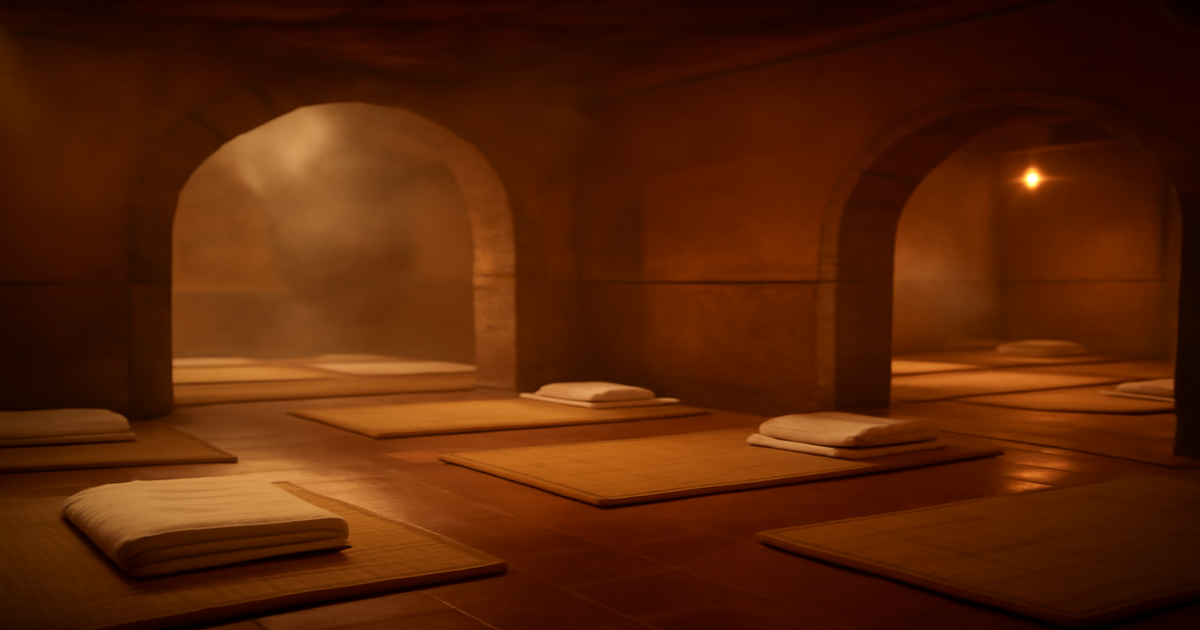
The jjimjilbang is one of the few places in Korea where a person can spend most of a day for roughly the price of two coffees. That single fact explains more about the business than any account of steam rooms and clay ovens. Bathhouses do not sell heat; they sell hours. And in a country where floor space is expensive, cafés move customers along, and hotel rooms are priced by the night, a business that sells long, unpoliced stretches of time at a flat rate occupies a commercial niche almost nothing else fills.
The form has deep roots. Public baths spread during the colonial period and remained necessary infrastructure for decades afterward, because most housing lacked private hot water. The neighborhood mokyoktang was a utility, like a water tap. What changed in the 1990s was that plumbing caught up with the population, and the bath had to become something other than a necessity. The answer was the jjimjilbang: the wet bathing area kept as a base, and around it a dry complex of heated rooms, sleeping halls, snack bars, television lounges, massage chairs and PC corners. It stopped being a place you visited for twenty minutes and became a place families entered in the afternoon and left after dark, in matching cotton shirts and shorts.
The economics of that shift are worth spelling out. Admission is deliberately low, because admission is not where the money is. Once inside, customers buy sikhye and steamed eggs, cold noodles and instant ramyeon, body scrubs from independently contracted scrubbers, drinks and ice cream, sometimes a haircut or a nap in a paid quiet room. The operator’s largest costs — the building, the boilers, the pumps, the piping — are largely fixed and already sunk. Marginal cost per additional guest is small once the water is hot and the kilns are fired. High volume against a low ticket price is not a failure of pricing; it is the model. It is also why a bathhouse tends to be either comfortably full or quietly dying, with little middle ground.
The night shift matters as much as the day. Because the facility is staffed and heated anyway, staying open around the clock converts idle hours into revenue. The customers who arrive after midnight are people who missed the last subway, travelers between cities, workers on odd shifts, men avoiding a fight at home, budget tourists treating the sleeping hall as accommodation. Few Korean businesses can offer a safe, warm, supervised place to lie down at that price, and no hotel can compete on the low end without losing money.
The pressures on the sector are real and mostly external. Fuel is the largest variable cost, so every energy price spike squeezes margins directly. Owners tend to be older, and succession is thin. Water quality inspections, fire safety rules tightened after deadly bathhouse and sauna fires, and general licensing obligations add compliance cost to a low-margin business. Most decisive is land: a sprawling low-rise structure on a valuable urban lot is an invitation to redevelopment, and many closures are property decisions rather than trading failures. The pandemic accelerated all of this, since shared water and shared air were precisely the wrong product for that moment.
Yet the persistence is equally structural. Korean leisure spending has moved toward cafés, camping, screen golf, hotel staycations and streaming, and none of those substitutes for what a bathhouse actually provides: a low-cost, low-obligation public interior where age and income are less visible than usual. For older Koreans living on modest pensions, it is one of the few affordable social spaces open all day. For families it absorbs children cheaply. For hikers it completes a ritual. The bathhouse endures not because Koreans are nostalgic about scrubbing, but because the cost of an hour spent there remains among the lowest on offer.