An economy that lives and dies by its exports
Exports are worth close to 40 percent of South Korean output and about a fifth of them are semiconductors, which means one product cycle can swing the national trade balance from record surplus to deficit.
Few developed economies are as exposed to foreign demand as South Korea. World Bank national accounts have put exports of goods and services at around 40 percent of gross domestic product through the early 2020s, roughly double the ratio for Japan and several times that of the United States. For a country of 52 million people with almost no domestic energy and limited raw materials, the arithmetic is not a strategy so much as a constraint: imports must be paid for, and manufactured exports are how that is done.
Within that export basket, one product dominates. Semiconductors have accounted for close to a fifth of Korea’s merchandise exports in strong years, according to customs figures compiled by the Korea International Trade Association. Add petrochemicals, automobiles, ships and displays, and a handful of capital-intensive sectors explain most of the total. This concentration is the product of decades of policy and corporate investment, and it delivered the world’s largest share of memory chip production. It also means the country’s trade accounts are effectively a leveraged bet on a single, famously volatile capital goods cycle.
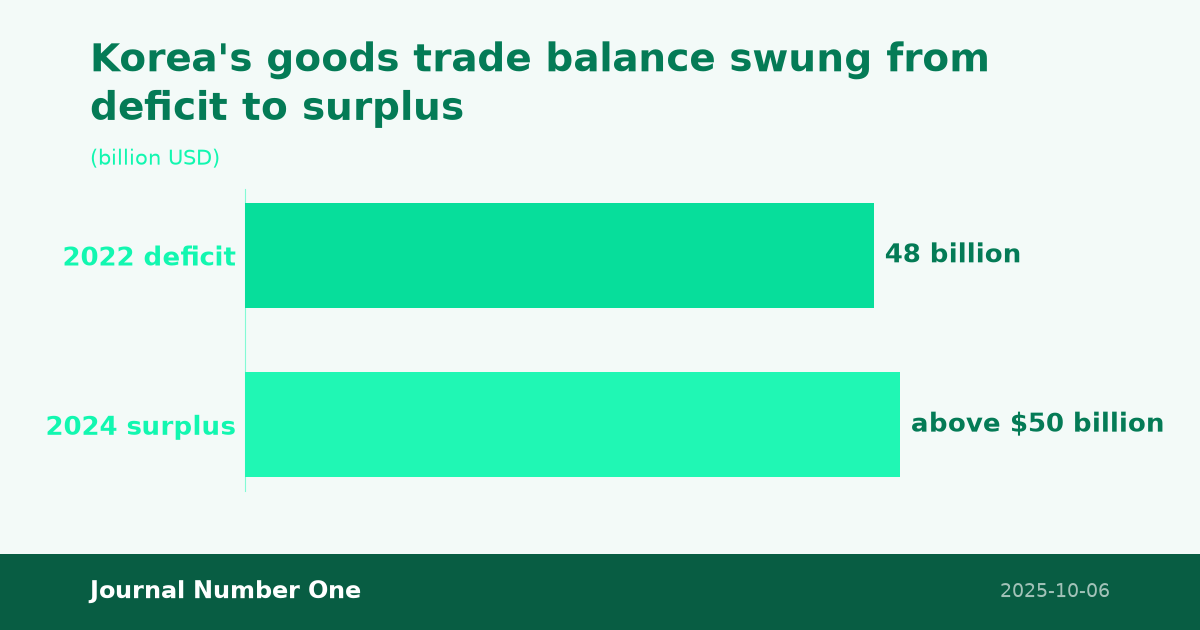
The evidence for that arrived in short order. Korea recorded a goods trade deficit of roughly $48 billion in 2022, its first annual deficit since the global financial crisis, as energy import bills surged and chip prices fell. The deficit narrowed but persisted into 2023, when semiconductor export values dropped by roughly a fifth year on year. When memory prices recovered, the accounts swung back: customs data showed a goods surplus above $50 billion in 2024 on record annual exports. Nothing about the underlying economy changed much across those three years. The price of one commodity did.
The destination mix has been shifting at the same time. China absorbed more than a quarter of Korean exports at the peak in the late 2010s, largely as intermediate goods feeding Chinese assembly lines. That share fell to around 19 percent by 2023 and 2024, while the United States climbed toward a comparable weight on the back of automobiles, batteries and machinery. ASEAN countries, taken together, now rival China as a destination. Some of this is deliberate diversification and some of it is displacement, as Chinese manufacturers meet at home the demand Korean suppliers used to serve.
Diversification is easier to announce than to achieve, because the concentration is in products rather than in customers. Selling memory chips to more countries does not reduce exposure to memory prices. The genuinely different revenue streams that have emerged — defence equipment, nuclear plant construction, shipbuilding for liquefied natural gas carriers, and cultural content — are real but small next to semiconductors, and several of them are lumpy, order-driven businesses with their own cycles.
The domestic consequence is that Korean macroeconomic policy spends much of its time managing the transmission of foreign shocks. A weak chip cycle shows up as a current account swing, a weaker won, higher imported inflation and, eventually, pressure on interest rates. A strong one produces the opposite, along with an equity market rally concentrated in two companies. Household consumption, meanwhile, has grown slowly through both phases, constrained by debt service and an ageing population, which leaves few offsets when external demand turns.
None of this is new information to Korean policymakers, who have been describing the export dependence as a vulnerability since at least the 1997 crisis. The difficulty is that the industries most capable of absorbing capital and generating high-wage jobs are precisely the export industries, so measures to rebalance toward services and domestic demand run against the grain of where the country’s comparative advantage — and its investment — actually sits.