Ramyeon became a billion dollar export and it was not an accident
Korean instant noodle shipments passed a billion dollars in 2024 after nearly a decade of compounding growth, pulling seaweed, sauces and frozen gimbap into the same slipstream.
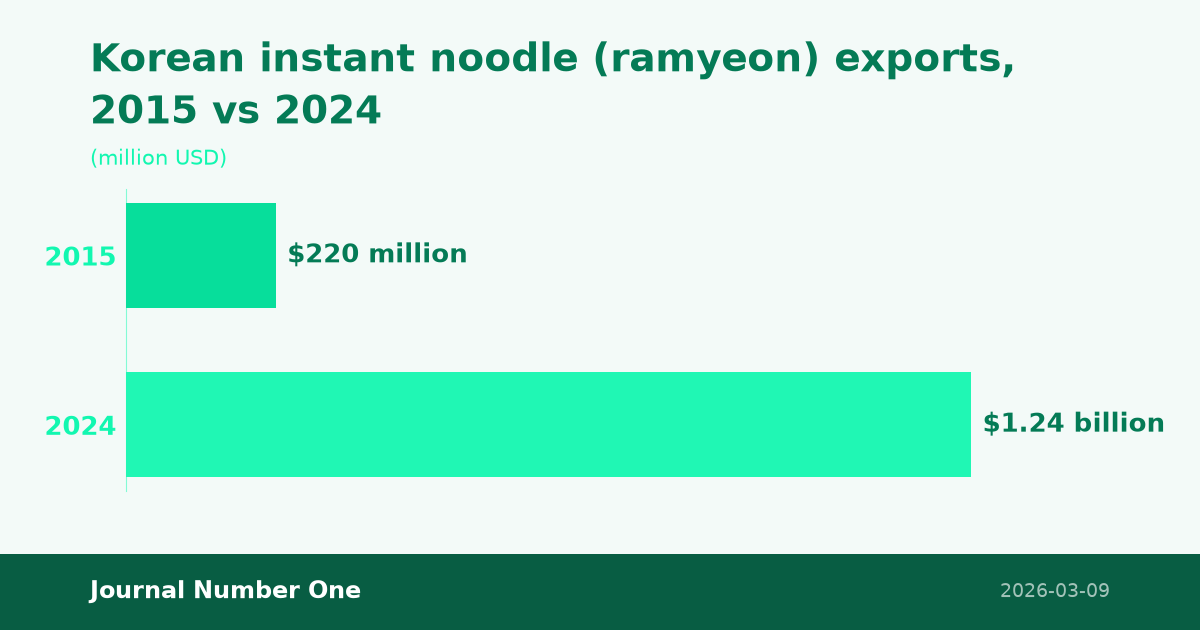
Korea’s agricultural and food exports have spent the past decade doing something the country’s manufacturing statistics rarely permit: growing steadily from a small base without a single dominant customer. The clearest case is instant noodles. Ramyeon shipments were worth roughly $220 million in 2015. They reached about $470 million in 2019, $765 million in 2022, $952 million in 2023, and crossed a billion dollars in 2024, ending near $1.24 billion. Customs figures record double-digit annual growth in most of those years, and the growth continued through periods when semiconductors, ships and petrochemicals were all contracting.
The composition of the demand changed as much as its size. For most of the 2000s, Korean instant noodles sold abroad primarily to Korean communities and to ethnic grocery channels. The buyers of the past several years are mainstream retail: mass-market chains in the United States, hypermarkets in Europe, convenience chains across Southeast Asia. That transition required a distribution achievement — clearing the compliance and shelf-space requirements of large Western grocers is slow, unglamorous work — and it followed a demand shift the manufacturers did not create.
The demand shift came from screens. A generation of viewers encountered Korean food as set dressing in television drama and film, then as the substance of the enormous mukbang and cooking-video genre, and finally as a participatory internet format: the fire noodle challenge, built around one manufacturer’s extremely spicy product, ran on video platforms for years and functioned as free global advertising of a kind no food marketing budget buys. The 2019 film Parasite put a specific instant noodle dish in front of audiences who had no prior category for it. None of this was planned, but the manufacturers responded quickly, and the products that grew fastest were the ones that had a video attached.
Supply-side work made the demand convertible. Korean exporters invested in halal certification, which opened Indonesian and Malaysian markets and the wider Muslim consumer base — a substantial undertaking for products whose broths were traditionally meat-based. Several producers built or expanded overseas plants, in the United States and China, to shorten supply lines and to reduce exposure to shipping costs, and reformulated products for local salt and spice tolerances. Vegetarian and vegan variants opened a different set of shelves in Europe.
The category effect is the more interesting part. Seaweed, historically a domestic staple with a modest export line, became a genuine export commodity as the snack format found buyers abroad, and Korean seaweed exports have been reported at around or above $1 billion in recent years, at times rivalling ramyeon. Frozen gimbap — rice rolls that survive freezing and reheating, a product that barely existed as an export item before 2023 — sold out in American retail chains after circulating on short-video platforms, and became a case study in how quickly a small Korean manufacturer can be pulled into an export market it did not plan for. Sauces, particularly gochujang, and processed rice products have followed similar if smaller trajectories.
The agriculture ministry has treated all of this as an industrial policy target rather than a windfall, setting successive annual export goals for agri-food and adjacent products, funding overseas certification and logistics support, and grouping the whole under the K-food label. The targets have generally been met, which is unusual for export targets and suggests they were set behind the trend rather than ahead of it.
There are limits worth naming. The absolute numbers remain small against Korea’s headline exports — a billion dollars is a rounding item next to semiconductors — and much of the value sits with a handful of large processors rather than with farmers, since the wheat in the noodles is imported. Food fashions reverse, and a category built partly on internet novelty carries the risk that attaches to novelty. But the past decade’s growth was not a single viral moment; it was nine or ten consecutive years of compounding, which is the pattern of a market being built rather than a fad being ridden.