Koreans travel abroad far more than visitors come in
Korea has run a travel deficit for most of two decades, and the duty-free industry built on Chinese bulk buyers has been unwinding since the visitors it depended on stopped arriving in the same form.

Korea sells the world semiconductors, ships and cars, and buys back holidays. The travel account — the tourism component of the current account, covering what residents spend abroad against what foreign visitors spend at home — has been in deficit for most of the past two decades, and the deficit is not small. Bank of Korea figures put it in the vicinity of ten billion dollars or more in a typical recent year, a persistent drag that sits inside an overall current account surplus generated by manufactured exports.
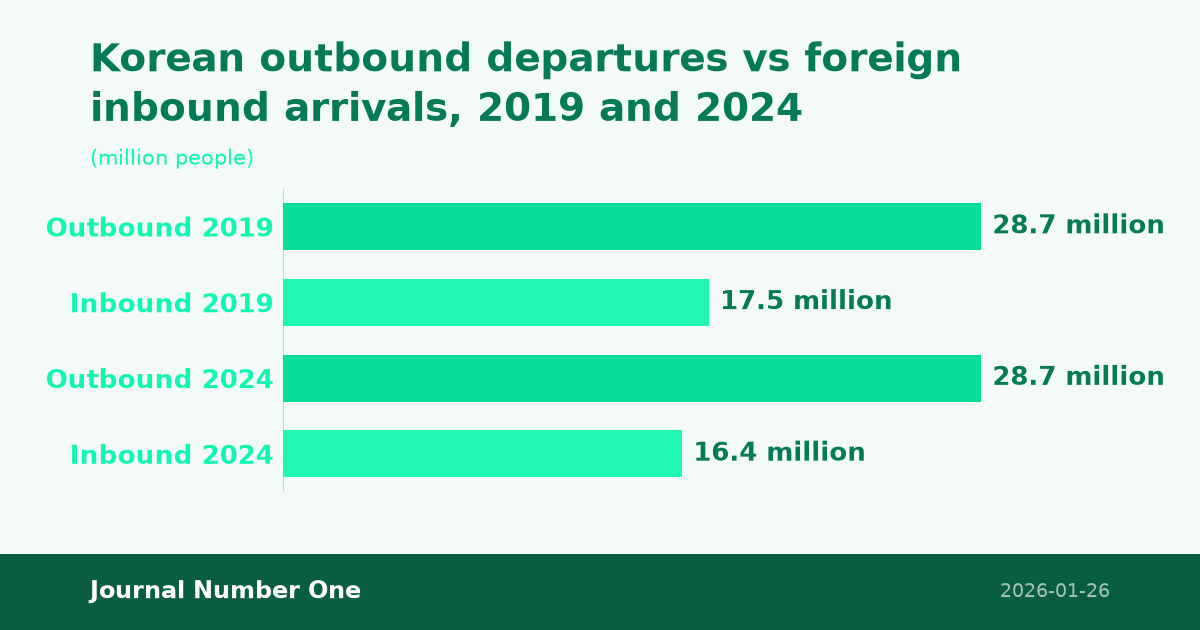
The underlying asymmetry is visible in headcounts. In 2019, the last full year before the pandemic, roughly 28.7 million Korean residents departed on overseas trips while about 17.5 million foreign visitors arrived, a gap of more than eleven million people. The pandemic closed both flows and reopened them at different speeds. Outbound travel recovered first and almost completely: by 2024 Korean departures were back around 28.7 million, essentially the pre-pandemic level. Inbound arrivals lagged, reaching roughly 16.4 million in 2024 — a strong recovery in percentage terms, but still short of 2019 and short of the outbound number by a wide margin.
Two currency stories explain much of the 2023 and 2024 pattern. The yen’s long slide made Japan extraordinarily cheap for Korean travellers, and Japan became by some distance the most-visited destination, absorbing a large share of the short-haul weekend trips that had previously gone to Southeast Asia or stayed domestic. Domestic tourism, meanwhile, had priced itself awkwardly during the closed-border years, when island and coastal resorts raised rates against captive demand; when the borders reopened, a weekend in Osaka often undercut one in Jeju, and travellers noticed.
The inbound side has been reshaped by the reconstruction of Chinese travel. Before 2017, Chinese group tours were the load-bearing structure of Korean tourism and, more specifically, of the duty-free industry. That industry’s economics were unusual: a substantial share of sales went not to individual tourists but to daigou, professional bulk purchasers who bought cosmetics and other high-turnover goods in volume for resale in China. Duty-free operators competed for that business by paying travel agencies and intermediaries commissions that at times consumed a large fraction of gross margin, producing an industry with enormous revenue and thin, sometimes negative, profit.
That model has been unwinding. Chinese group travel to Korea was curtailed after 2017, resumed only partially, and the composition of Chinese visitors shifted toward independent travellers who spend differently — more on food, accommodation and experiences, less on bulk cosmetics. Chinese domestic duty-free capacity, particularly on Hainan, absorbed part of the demand that used to cross the sea. Korean operators reported successive years of weak or negative operating profit through 2023 and 2024 despite recovering visitor numbers, and the sector consolidated: downtown store closures, reduced airport concession commitments and renegotiated rents at Incheon followed. The revenue that returned was not the revenue that had left.
What replaces it is an open question with a partial answer already visible. Inbound spending has been shifting toward categories that Korean cultural exports built the appetite for — food, cosmetics purchased retail rather than wholesale, concerts, medical and cosmetic procedures — and toward visitors from Japan, Taiwan and Southeast Asia whose numbers recovered faster than China’s. That mix is lower in volume per visitor but healthier in margin and less exposed to a single bilateral relationship.
The travel deficit itself is unlikely to close. A country whose residents are wealthy, whose currency buys a great deal in nearby destinations and whose own landmass offers a limited stock of beach and mountain will import leisure. The more consequential question is whether the inbound half stops being an industry organised around one type of buyer, which is the arrangement that made the previous decade look better than it was.