Korea buries thousands each year with no one to claim them
Unclaimed deaths have risen past four thousand a year, municipalities now run public funerals for people whose families decline them, and the rites themselves have shrunk almost beyond recognition.
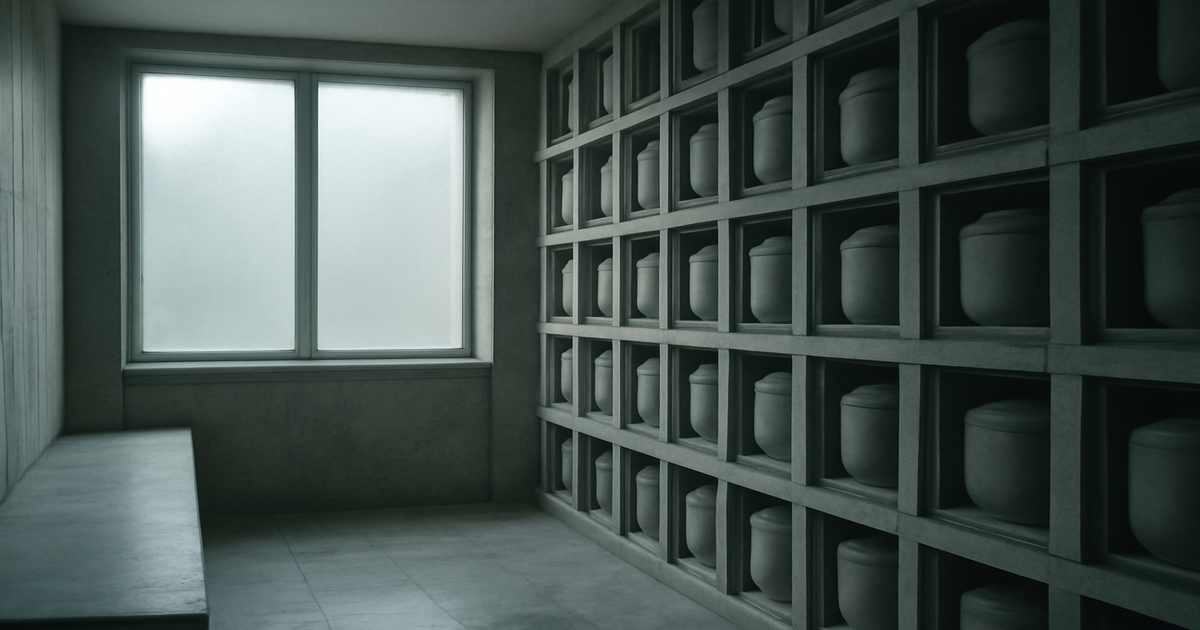
The administrative term is muyeongo samang — death without a connection — and it covers two situations that the statistics combine. One is the person who genuinely has no surviving relatives. The other, now the larger category, is the person whose relatives are known, are contactable, and decline to claim the body. Under Korean practice a family that accepts remains also accepts the funeral costs and, historically, a set of legal entanglements around the estate; refusal is a documented and increasingly common choice, particularly where the relationship had lapsed decades earlier.
The count has risen steadily. Welfare ministry figures reported through 2023 and 2024 put unclaimed deaths above four thousand a year nationally, roughly double the level of the late 2010s. The demographic profile is not the one that the phrase dying alone tends to evoke. Men substantially outnumber women, and the largest concentration is among people in their fifties and sixties rather than the very old — a cohort that separated or divorced during or after the 1997 financial crisis, lost stable employment, moved into single-occupancy rooms in older urban districts, and fell out of contact with children who were minors at the time. A related official category, godoksa, counts deaths in isolation discovered after some interval, and a government survey published in 2024 estimated those at over three thousand a year, again heavily male and heavily middle-aged.
The public response has been municipal and recent. Seoul and several other local governments began operating public funeral programmes in the late 2010s, extending them through the early 2020s, under which the city arranges a cremation and a short ceremony for residents who die unclaimed, including those whose families formally waive the body. The programmes are modest in cost and were justified in terms of dignity rather than public health. A national framework followed, giving the practice a statutory basis in place of a patchwork of local ordinances. Volunteer and religious organisations supply the attendance that families do not.
Behind the specific problem sits a general transformation of Korean funerary practice that has moved faster than almost any other cultural change of the past forty years. In 1990 burial was the overwhelming norm and cremation accounted for less than a fifth of deaths; by the early 2020s the cremation rate had passed ninety percent, one of the highest in the world. The reversal was driven by land scarcity, by the cost and maintenance burden of family grave sites, and by a state that priced and permitted accordingly. Charnel houses, natural burial under trees and scattering have absorbed the remains that hillsides used to.
The ceremony has contracted in parallel. The three-day funeral held in a hospital funeral hall, with a continuous stream of colleagues and business acquaintances delivering condolence money, was for decades a durable social institution and a real financial mechanism — the envelopes routinely covered the cost of the event. Shorter formats, family-only rites and, since the pandemic normalised them, funerals without the customary volume of visitors have become ordinary. The condolence-money economy that made large funerals self-financing weakens as the networks feeding it thin out.
The industry has followed the money. Korean funeral services consolidated around a small number of national providers selling prepaid funeral plans, a market large enough to attract regulatory attention over the security of customer deposits after several operators failed. The same firms increasingly sell to people arranging their own funerals in advance — a product that exists because a growing share of customers cannot assume anyone will do it for them.
That is the quiet centre of the whole subject. A funeral is a claim made by the living on behalf of the dead, and Korea is producing more people about whom no such claim will be made. The public programmes are a decent institutional answer to a problem that is not institutional in origin, and their caseload is the closest thing the country has to a running measure of how many of its social ties have come apart.