The Korean military is running out of eighteen year olds
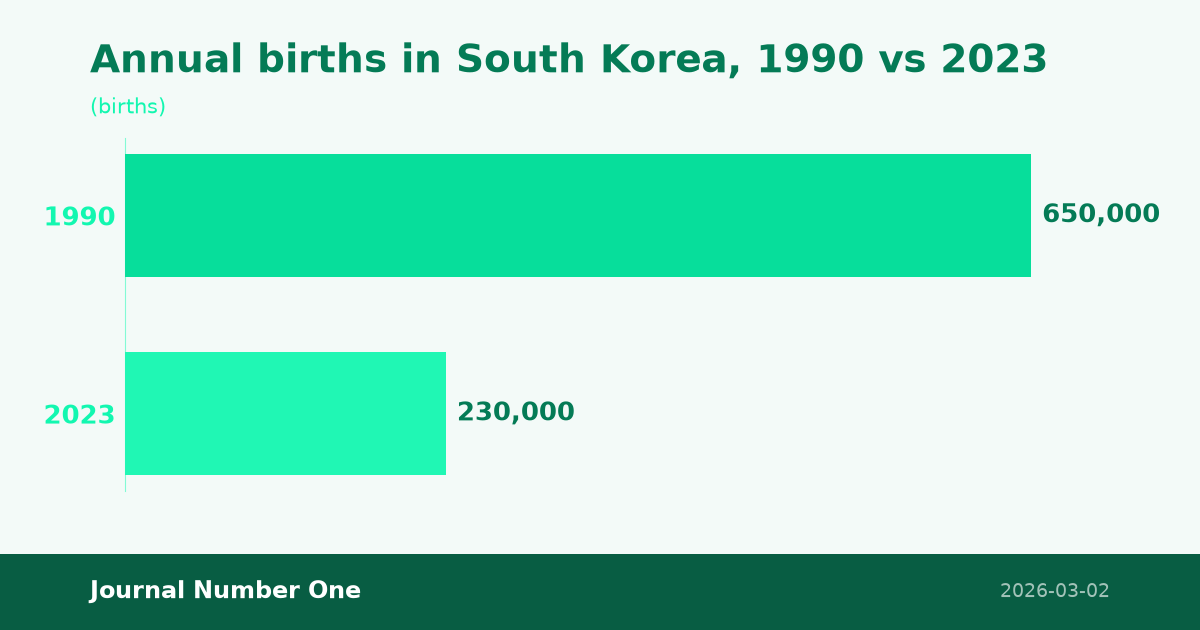
A conscript army sized for a country of 650,000 annual births now draws on birth cohorts less than half that, and shortened service and thin officer recruitment leave little slack in the arithmetic.

Conscription in South Korea is a demographic instrument before it is a military one. Every physically eligible man serves, so the size of the standing force is set, with a lag of about nineteen years, by the number of boys born. That relationship was comfortable when Korea produced more than 600,000 babies a year. It is not comfortable now.
The birth series tells the story without commentary. Korea recorded roughly 650,000 births in 1990 and about 640,000 in 2000. The figure fell to around 470,000 in 2010, dropped below 300,000 in 2020, and stood near 230,000 in 2023 — the lowest on record and less than a third of the 1990 level. Since roughly half of each cohort is male and a further portion is exempted or assigned to alternative service on medical or other grounds, the annual pool of conscripts available at age twenty follows the same curve with a two-decade delay. The cohorts now reaching enlistment age were born around 2006, when births were near 450,000; the cohorts of the late 2030s were born in years when births were half that.
The force has already been shrinking to match. Successive defence reform plans reduced the standing army from around 690,000 personnel in the mid-2000s toward a target closer to 500,000, and defence ministry figures through the early 2020s showed the actual total falling below that target rather than settling on it. Reserve strength has been cut in parallel. The reductions were presented as modernisation, and in part they were; but the schedule was set by the population projections, not by an assessment of how few soldiers the tasks require.
Two policy choices have narrowed the room for further adjustment. Army conscript service was progressively shortened, reaching eighteen months in the early 2020s from twenty-six months two decades earlier, with navy and air force terms proportionally longer. Shorter service means each conscript is available for fewer months, so a given force size requires proportionally more intakes from a shrinking pool — the reduction in term length cost roughly a quarter of the standing conscript strength on its own. Restoring the older term is politically implausible; every attempt to discuss it publicly has been abandoned quickly.
The second squeeze is on the professional cadre that was supposed to absorb the difference. If there are fewer conscripts, the doctrine goes, the force becomes smaller, more technical and more heavily staffed by career non-commissioned officers and officers. Recruitment has not cooperated. Applications to the army’s short-service officer and NCO tracks fell through the early 2020s, with several officer intake competitions drawing near or below one applicant per place — a striking figure in a labour market where public-sector examinations are typically oversubscribed. The reasons are unromantic: compensation and housing that compare poorly with civilian alternatives, postings to remote units, and the well-publicised fact that the conscript stipend was raised sharply over the same period, compressing the gap between serving under compulsion and serving by choice.
The institutional response has been technological and administrative. Defence planning documents through 2023 and 2024 have emphasised unmanned systems, surveillance and reconnaissance assets, artificial intelligence in command support, and manned-unmanned teaming, on the argument that capital can substitute for the soldiers the population will not supply. Separately, standards for physical eligibility have been relaxed repeatedly, which raises the share of each cohort deemed fit for active duty and buys perhaps a few years. Proposals to enlarge the pool by other means — recruiting more women into non-conscript roles, or introducing a formal reserve conversion — surface regularly and progress slowly.
None of these mechanisms alters the underlying series. The cohorts that will reach enlistment age in the 2040s have already been born, and the count is known. Whatever force Korea intends to field in that decade will be designed around a number that no policy adopted afterwards can change.